
Some things need to be asked…
A Challenge to Lefebvrism:
Some Inconvenient Questions for the Society of St. Pius X

Long-time readers of this blog know that we have critiqued and exposed the errors of the Society of St. Pius X (SSPX), founded by Abp. Marcel Lefebvre, many times. Here are some examples:
- The Unsolvable Pendulum Problem of the Society of St. Pius X
- The SSPX and ‘Pope’ Francis: Theological Absurdistan on Full Display
- Pope Pius IX condemns Lefebvrist Theology
- SSPX Superior General blasts ‘Traditionis Custodes’: A Sedevacantist Critique
- Five SSPX Myths Debunked? Novus Ordo Watch Answers Kennedy Hall
- Pope Pius IX’s Syllabus of LEFEBVRIST Errors (1873)
In view of the schism controversy surrounding the upcoming SSPX episcopal consecrations, it will be appropriate to reissue, in somewhat modified and updated form, a challenge to the clergy and/or lay adherents of the SSPX that was first published years ago. The challenge consists of a series of uncomfortable but important questions — a set of ‘dubia’, if you will — which anyone who endorses the Lefebvrist recognize-and-resist position in good faith should not mind answering.
Insofar as applicable, all questions ought to be responded to using documentation from authoritative Catholic magisterial sources, such as papal encyclicals, decrees of ecumenical councils, or approved catechisms or theological manuals from before the death of Pope Pius XII (Oct. 9, 1958). Invoking such novel concepts as “partial communion” or “Eternal Rome vs. Present-Day Rome” is not acceptable, as such ideas have no foundation in Catholic teaching and actually run contrary to it. In addition, anyone answering these questions ought not to seek refuge in vague formulations or ambiguous expressions: “But let your speech be yea, yea: no, no: and that which is over and above these, is of evil” (Mt 5:37). Please answer clearly, directly, straightforwardly. You may do so in the combox below, by contacting us here, or by publishing your response on your own blog or site.
Dear SSPX cleric or lay adherent:
- Are you, or are you not, in communion with Leo XIV and his religion?
- Do you agree that, in the final analysis, it is for the Pope and the Pope alone to say who is and isn’t in communion with him, as Pope Pius IX teaches? “Most men feel that the Church’s supreme head and shepherd should decide who are Catholics and who are not” (Encyclical Quartus Supra, n. 15).
- Do you agree, as the First Vatican Council teaches, that “in the Apostolic See the Catholic religion has always been preserved untainted, and holy doctrine celebrated” (Denz. 1833)?
- Do you agree, as the First Vatican Council teaches, that Leo XIV, whom you insist on recognizing as the Pope of the Catholic Church, “is the supreme judge of the faithful,” of whom you consider yourselves a part, “and that in all cases pertaining to ecclesiastical examination recourse can be had to his judgment; moreover, that the judgment of the Apostolic See, whose authority is not surpassed [not even by the SSPX], is to be disclaimed by no one, nor is anyone [including the SSPX] permitted to pass judgment on its judgment” (Denz. 1830)?
- Do you submit to Leo XIV in the same manner as you would have submitted to Pope St. Pius X had you lived during his reign?
- Do you agree with the teaching of Pope Pius XII, namely, that “Jesus Christ, hanging on the Cross, opened up to His Church the fountain of those divine gifts, which prevent her from ever teaching false doctrine and enable her to rule them for the salvation of their souls through divinely enlightened pastors and to bestow on them an abundance of heavenly graces” (Encyclical Mystici Corporis, n. 31)?
- Do you assent to the teaching of Pope Leo XIII, namely, that the Catholic Church “is the continuation of the mission of the Saviour” and that it “makes no terms with error, but remains faithful to the commands which it has received to carry the doctrine of Jesus Christ to the uttermost limits of the world and to the end of time and to protect it in its inviolable integrity” (Apostolic Letter Annum Ingressi)?
- Do you agree with Pope St. Pius X’s teaching that “the first and greatest criterion of the faith, the ultimate and unassailable test of orthodoxy is obedience to the teaching authority of the Church, which is ever living and infallible….”? (Allocution Con Vera Soddisfazione, May 10, 1909)
- Who has the final say on what is orthodox doctrine — Rome or the SSPX headquarters in Menzingen, Switzerland? If Rome doesn’t have the final say in our day, why did it have the final say in 1910 (for example), and when did it switch from “final say all the time” to “final say sometimes, depending on what they decide, as judged by Menzingen”; and who decided that?
- In his encyclical Satis Cognitum, Pope Leo XIII teaches: “You are not to be looked upon as holding the true Catholic faith if you do not teach that the faith of Rome is to be held” (n. 13; quoting St. Augustine). Do you believe and teach “the faith of Rome”?
- Do you believe that the Catholic Church, which is the Bride of Christ, “regards with sincere reverence those [Pagan] ways of conduct and of life, those precepts and teachings which, though differing in many aspects from the ones she holds and sets forth, nonetheless often reflect a ray of that Truth which enlightens all men” (Vatican II, Declaration Nostra Aetate, n. 2)? Do you believe that ‘Pope’ Paul VI, “by the Apostolic Authority handed down to Us from Christ, together with all the Venerable Fathers, in the Holy Ghost approve[d], decree[d] and establish[ed] these things” and, furthermore, that Paul VI, by his supposed apostolic authority, ordered these things “to be promulgated unto the glory of God”, as the conciliar document says at the very end (see Latin original here)?
- Suppose for a minute that Paul VI was not a valid Pope, as we Sedevacantists argue. Would you then agree that all of the sacramental rites he promulgated in which the essential matter or form were changed, could be invalid?
- If you answered ‘yes’ to the previous question, do you agree then that Sedevacantism is the safer course to take, just in case it should turn out that Paul VI was indeed not a valid Pope?
- If there should be a dispute among SSPX clerics on how to answer any of these questions, why is that, and who gets to decide which set of answers constitute the ‘real’ traditional Catholic position?
- If you dislike any of these questions, why is that?
For an organization that claims to teach and uphold traditional Roman Catholicism, these questions ought not to cause offense, nor confusion, nor consternation.
For anyone reading this who is not an SSPX supporter, please feel free to forward this list of questions to someone you may know who attends a Lefebvrist chapel or is part of their organization.
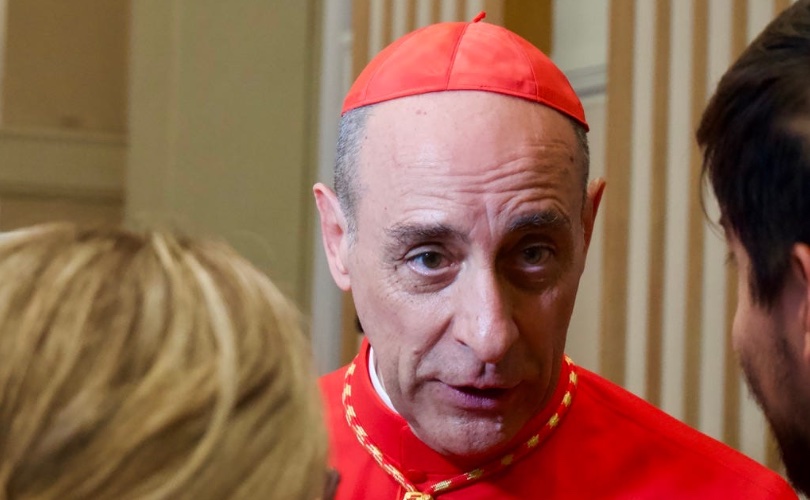
By the way: The sedevacantist bishop Donald Sanborn, who was once a priest with the Society and ordained by Abp. Marcel Lefebvre in 1975, provides an insightful critical commentary on SSPX Superior General Fr. Davide Pagliarani’s Feb. 18 response to ‘Cardinal’ Tucho Fernandez. In the below video, Bp. Sanborn contrasts the Lefebvrist approach with the traditional Roman Catholic doctrine the SSPX claims to be defending, thereby showing how antithetical to real Catholicism it actually is:
.
The video can also be watched directly on YouTube here.
We ought to pray that the eyes of the many good-willed and pious souls caught up in the various recognize-and-resist systems be opened to the true nature of the Mystical Passion of the Church, for all the deceptive power of the Counterfeit Church in Rome lies in its being mistaken for the Roman Catholic Church founded by the Son of God, our Blessed Lord and Savior Jesus Christ.
Image source: Shutterstock (Albino Abreu)
License: paid

 ;
;
No Comments
Be the first to start a conversation