
Prepping his audience for a future ‘canonization’?
Taylor Marshall Says He Prays To ‘Pope’ Francis:
“I Ask Him to Pray For Me”

What has happened to Taylor Marshall? That is a question not a few people are asking themselves these days.
Ever since the election of Robert Francis Prevost as ‘Pope Leo XIV’ — or, to be more precise, ever since the day after the election of Leo XIV — the philosophy professor, author, former Anglican priest, and now professional influencer, podcaster, and liver cleanser salesman Dr. Taylor Marshall has shifted away from his hardcore recognize-and-resist position that catapulted him to fame beginning around 2018.
At this point, Marshall takes a much more conciliatory position vis-a-vis the post-Catholic Vatican and tries to shape his narrative accordingly. The watershed moment seems to have been when he switched from opposing the new ‘Pope’ Leo XIV on the day of his election — whom he had denounced just days prior as the worst possible choice of those cardinals that had a realistic chance of getting elected — to declaring his loyal support the following day. The explanation he gave for this sudden change of heart left a lot to be desired:
In the Sep. 10, 2026 edition of his podcast, Marshall addressed this issue once more, and repeated his lame defense.
There is something else he said during that episode, however, that really deserves some commentary, and which shows further just how conciliatory he has become towards the man he once denounced for his constant heresies, blasphemies, and impieties: Jorge Mario Bergoglio, otherwise known as ‘Pope Francis’.
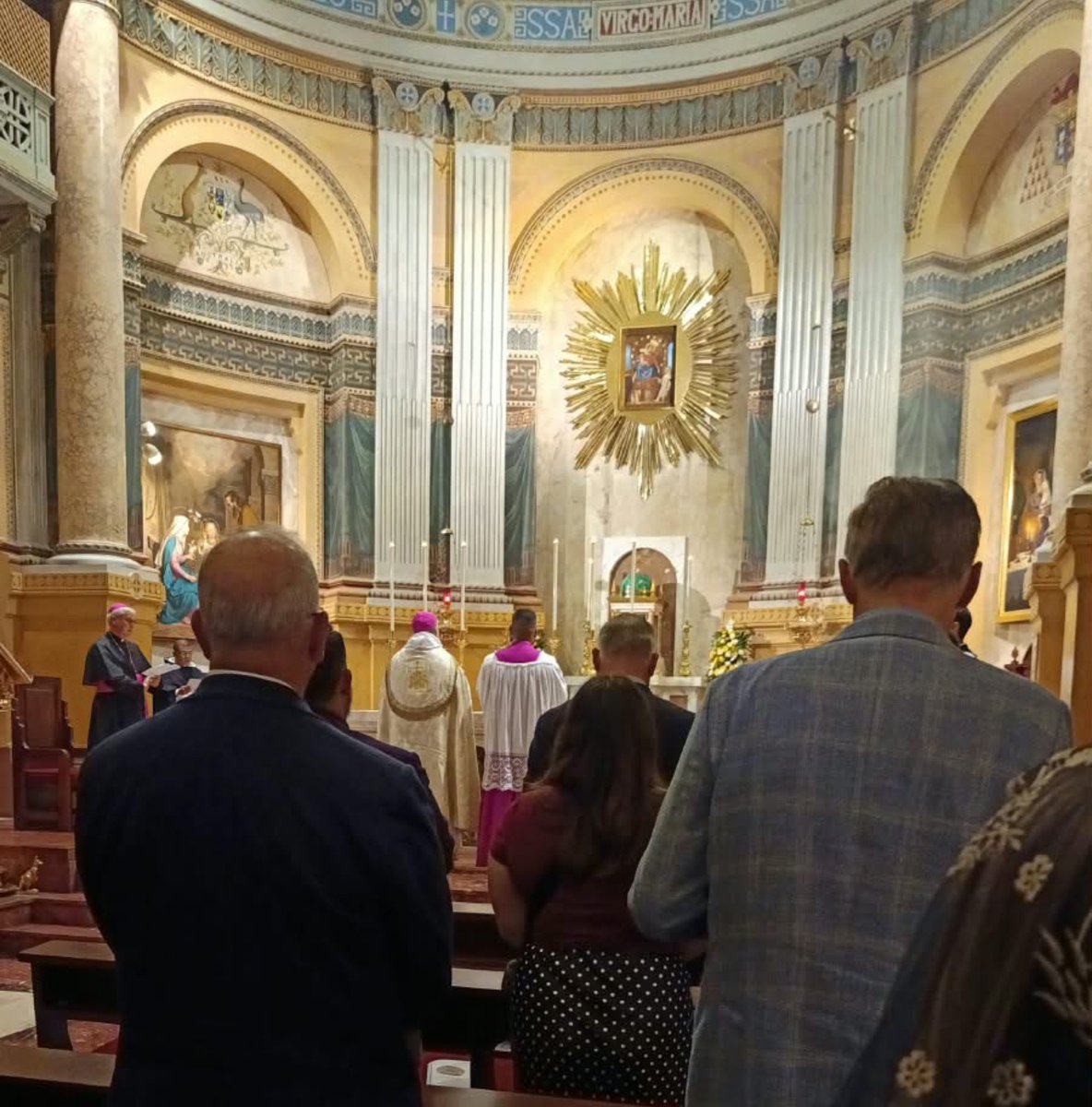
Marshall was addressing the recent news that the Vatican had denied the semi-traditionalist Summorum Pontificum pilgrimage permission to offer a Traditional Latin Mass in St. Peter’s Basilica. As a result, it will take place at the Roman Basilica of St. Mary Major instead, where Francis happens to be buried.
In this context, Marshall mentioned that he had been to Rome twice in recent years and that he visits Francis’ tomb when he is there:
But I go over to Pope Francis’ tomb and I pray for him, and I ask him to pray for me. He’s buried there in St. Mary Major, very plain tomb, not much there, just his pectoral cross on the wall. But I know that God desires all men to be saved, and I know that the Holy Trinity desires Pope Francis to be saved, and he desires me to be saved. And so I just pray for him. I entrust him to the mercy of God.
(Taylor R. Marshall, “Latin Mass Pushed OUT of St. Peter’s: For Now”, YouTube, Sep. 10, 2026, beginning at the 12:36 mark. Emphasis added.)
We made the following short video highlighting Marshall’s scandalous remark (direct link here):
.
Before we proceed further, let’s be clear about something: Yes, of course God desires the salvation of all (see 1 Tim 2:4). We too must desire the salvation of all who are still capable of being saved, for we cannot love God if we hate our brother (see 1 Jn 4:20); and we cannot be said to be truly loving our brother if we do not desire for him the greatest good of all, which is eternal bliss in heaven.
These considerations, however, are entirely irrelevant to the question whether or not Bergoglio was in the state of sanctifying grace when God called him to judgment on Apr. 21, 2025. If he did indeed die reconciled to God, then he will certainly go to heaven; if he did not, then he is already in hell, damned for all eternity.
What, then, is the problem with what Marshall said?
The fundamental problem that it gives scandal. The professional influencer just disclosed to a worldwide audience, effectively, that he asks a deceased public sinner — which Francis most definitely was — for his intercession. In fact, it is worse; for not only was Francis a public sinner (sinful Catholic), he was a public apostate, a man whose public teachings, remarks, and actions continually demonstrated that he had abandoned the Roman Catholic Faith altogether. Ironically, the evidence against Bergoglio was frequently presented on Taylor Marshall’s own show.
Nevertheless, even if one were to take the position that Francis was not a public apostate but still somehow qualified as a Roman Catholic, the scandal would still be immense since he was certainly a most notorious and publicly unrepentant sinner. His list of public offenses against Faith and morals is nearly endless, as the following link shows:
Why is it scandalous to ask for Bergoglio’s intercession? There are at least two reasons.
First, most people who listen to Marshall’s podcast will understand him to be implying that Francis might be in heaven. While this cannot be ruled out absolutely, since we do not know what transpired in private in the last few hours of his life, nor does the Faith tell us how time in purgatory relates to time here on earth, it is nevertheless an utterly grotesque idea because the likelihood of that being true is so infinitesimally small that it would be foolish even to consider.
Let’s think about this.
Francis was one of the greatest apostates in the world, perhaps the greatest. If Marshall wants to argue that we can pray to someone like him even, since there is a theoretical possibility he repented shortly before his death and received a valid absolution and died in the state of grace, whom else will Marshall invoke for intercession? Martin Luther? Karl Marx? Nebuchadnezzar? Vladimir Lenin? Adolph Hitler? Joseph Stalin? Fidel Castro? Emma Bonino?
For all of these, too, there exists a theoretical possibility they repented shortly before they had to render an account to their Divine Judge and so either were baptized, made a good confession, or died in perfect contrition just in time. Yet, would anyone be so foolish as to consider this theoretical possibility even remotely realistic enough to warrant praying to them? What sort of message would this send? Out all of the people one could be asking for spiritual assistance, who in his right mind would choose one of those characters when we have “so great a cloud of witnesses over our head” (Heb 12:1), true saints we know for sure to be incredibly powerful with God?
Second, although the Church does not condemn the idea of asking the souls in purgatory to intercede for us, it is not certain that they can — good arguments can be given both for and against this view. Whereas we know that the holy souls cannot intercede or merit for themselves, the Church simply has no definitive teaching on whether it is possible for them to pray for us on earth. The only people who can certainly intercede for us here below are the saints in heaven.
Thus one may find differing views in various catechisms and even among the saints and doctors. As Cardinal Pietro Gasparri explains:
It is disputed whether we can pray to the souls detained in purgatory to obtain their intercession for us with God.
The affirmative opinion is not only the one more generally accepted among theologians, especially more recent writers, but, what is of graver moment, it would seem to be in conformity with a general practice of the faithful which the Church has never opposed. Yet there are theologians of great reputation, some of whom quote against this view the words of St. Thomas [Summa Theologica, II-II, q. 83, a. 11, ad 3], where he teaches that “the souls in purgatory are not so much in a state to pray for us as for us to pray for them.” Not all Thomists, however, agree with this interpretation of his words, for some think that St. Thomas only means that the souls in purgatory have not the power to practice meritorious prayer — such as we have in this present life, nor the power of effective intercessory prayer which belongs to the state of glory. But he does not, so they maintain, mean to deny to them the capacity for such prayer as is common to all who have charity, a capacity for prayer which is a necessary feature of the Communion of Saints.
We ourselves regard the opinion which maintains that the holy souls can pray for us as certainly the correct one, more particularly because, as we have said, it is in harmony with a practice of the faithful which the Church has never opposed…. Still, if any competent authority feels that this view is unsound or not quite accurate it will be easy to correct the answers we have given.
(Peter Cardinal Gasparri, The Catholic Catechism [New York, NY: P. J. Kenedy & Sons, 1932], p. 451)
For clarity’s sake, we will quote St. Thomas Aquinas‘ words the way they appear in the commonly-used translation by the Fathers of the English Dominican Province, published in 1920. The Angelic Doctor says: “Those who are in Purgatory though they are above us on account of their impeccability, yet they are below us as to the pains which they suffer: and in this respect they are not in a condition to pray, but rather in a condition that requires us to pray for them” (S.T., II-II, q. 83, a. 11, ad 3).
In his magnificent work on purgatory, Fr. John Nageleisen (1861-1952) briefly summarizes this doctrine of St. Thomas and then explains:
But as the Church has not dogmatically declared for or against this doctrine, the question,”Can the souls in Purgatory, while in the state of suffering, intercede for us with God?” is an open one. Theologians are divided on it, and the Church tolerates the opinions of both sides. And if we ask the religious sentiment of Catholics in general, this question is confidently answered with, “Yes!” Most commentators of St. Thomas declare that his doctrine does not conflict with this opinion. According to the opinion of the Angelic Doctor — and his opinion is the general one — the Suffering Souls are not official intercessors for the Church militant in the same sense as are the saints in heaven. Their position is not that of intercessors, but of beneficiaries for whom we ought to intercede; our position, as far as gaining merit and helping them is concerned, being preferable to theirs. Our prayer, addressed to God in the state of grace, is always heard, according to our Savior’s own declaration, “If you shall ask Me anything in My name, that I will do.” (John xiv. 14.) These words were addressed to the living, not to the dead.
According to St. Thomas it is the will of God that the inferior should be assisted by the superior. Since it is true that the souls in Purgatory, by reason of their captivity, are in a state inferior to ours, it might seem, because of this inferior state, that they can not pray for us. But as they are also in a state superior to ours, since they are beyond the possibility of committing sin, does it not follow that they can pray for us? It is not necessary that they should possess every claim in order to be entitled to pray for us; it is sufficient that they possess one. Hence some followers of St. Thomas call the doctrine that the Suffering Souls can pray for us the common one. For as far as this second reason is concerned, they can be our intercessors the same as the saints in heaven, because they are in the grace and favor of God. Our motive of praying for the Suffer- ing Souls should be rather a desire to help them, than to receive their help. It should be our principal object to pray for their aid and deliverance, rather than to obtain their assistance. But their condition is no obstacle to their prayer for us. Gregory of Valencia maintains that the souls in Purgatory pray for the faithful in general, but particularly for those who were very dear to them on earth. Bellarmine, Suarez, Sylvius, Gotti, Jungmann and many others are of the same opinion.
(Rev. John A. Nageleisen, Charity for the Suffering Souls [Cincinnati, OH: Press of S. Rosenthal & Co., 1895], nn. 420-421, pp. 387-388)
In short: The Church Militant (Catholics on earth) seeks the assistance of the Church Triumphant (Catholics in heaven) and intercedes for the Church Suffering (Catholics in purgatory). But whether the Church Suffering can and does intercede for the Church Militant or not, is a question that has not been settled. Although, obviously, only one of these two mutually-exclusive positions can be true, nevertheless they are both perfectly safe to embrace since the Church permits us to hold either one.
Therefore, by telling the world that he is praying not only for Francis but also to him, Taylor Marshall is implicitly saying either (1) that there is a reasonable likelihood of Francis being in heaven, less than 18 months after his death; or (2) that there is a reasonable likelihood of Francis being in purgatory and a reasonable likelihood that the poor souls in purgatory do in fact intercede for us.
To understand further why Marshall’s remarks were scandalous, let’s review what scandal is:
Definition of Scandal.—In the strict sense, scandal is defined as “any conduct that has at least the appearance of evil and that offers to a neighbor an occasion of spiritual ruin.”
(a) By conduct is understood external behavior or manner of acting in the presence of others. Thus, scandal differs from sin, for sin is committed, not only by external acts done before others, but also by internal thoughts and desires and external acts that are secret.
(b) Scandal is conduct which is evil at least in appearance, that is, sinful, or from the circumstances seemingly sinful. Thus, an act is not scandalous, if it is morally indifferent or a less good, and is perceivable as being such.
(c) Scandal tends to spiritual ruin, that is, to a fall into sin, great or small. Here scandal strictly understood differs from scandal in the wide senses given in the previous paragraph.
(d) Scandal is an occasion of a fall into sin, that is, it sets an example of sin before the attention, and thus suggests to the will that the will imitate the sin. Scandal is not, however, the cause of sin, for a person causes his own sin in yielding consent to the suggestion offered by scandal.
(e) Scandal is to another. A person may be said to scandalize himself in the sense that by his looks or acts he puts himself in an occasion of sin (Matt., v. 29, 30), or inasmuch as he maliciously makes the acts of a virtuous neighbor an occasion of sin; but scandal is more properly understood of an occasion of sin prepared for one’s neighbor.
(Fr. John A. McHugh and Fr. Charles J. Callan, Moral Theology [New York, NY: Joseph F. Wagner, Inc., 1958], n. 1447; underlining added.)
To reveal that he asks the spiritual assistance of one of history’s greatest deceased apostates is at least seemingly sinful. It has at least the appearance of evil.
Furthermore, most people who hear this will infer, rightly or wrongly, that Marshall considers it a realistic possibility that Bergoglio is at this very moment beholding the Face of God in heaven, able to intercede for us. Such an idea — or even the belief that, though not presently in heaven, he is nevertheless on his way there as he waits for his fiery purgation to end — suggests that it is a relatively easy thing to repent just before death of so many evils committed in 12+ years of playing ‘Pope’. This, in turn, encourages laxity in morals and spiritual tepidity (lukewarmness).
The truth is, of course, that death bed conversions are extremely rare. Most people will die the way they have lived. It would be the height of folly to postpone one’s conversion until the end: “Delay not to be converted to the Lord, and defer it not from day to day. For his wrath shall come on a sudden, and in the time of vengeance he will destroy thee” (Ecclus [Sir] 5:8-9). “He that lives in sin till death shall die in sin”, warns St. Alphonsus Liguori (Sermon for the Ninth Sunday after Pentecost, n. 8) and exclaims: “Oh! how difficult is it for a sinner, who has slept many years in sin, to repent sincerely at the hour of death, when his mind is darkened, and his heart hardened!” (n. 3).
Thus, with his comments Marshall is offering people an occasion of spiritual ruin. Moreover, not a few of his fans will probably take his remarks as a reason to pray to Francis themselves.
All of this will soften people’s attitude towards a man who, as far as what can be known externally, continually denied, mocked, undermined, and fought against Roman Catholic beliefs and practices. His 12+ year record as ‘Pope’ demonstrates beyond the shadow of a doubt that he was an enemy of the Roman Catholic religion: “An enemy hath done this” (Mt 13:28); “By their fruits you shall know them” (Mt 7:16).
In this regard we should not forget that although we can never presume to judge a man’s interior disposition, which is known only to himself and to God, nevertheless we are able and allowed to identify who is an enemy of God based on what appears externally:
Although [the Modernists] express their astonishment that We should number them amongst the enemies of the Church, no one will be reasonably surprised that We should do so, if, leaving out of account the internal disposition of the soul, of which God alone is the Judge, he considers their tenets, their manner of speech, and their action.
(Pope St. Pius X, Encyclical Pascendi Dominici Gregis, n. 3; underlining added.)
And so it is clear that Taylor Marshall has effectively flaunted that he seeks the spiritual assistance of an enemy of the Faith and the Church.
This inevitably raises the question, why? Why do this? Why confuse people with such extremely unrealistic scenarios?
Let’s keep in mind that we are not merely talking about what some “dad with a webcam” is doing privately. One could say that whom Marshall prays for is his business. That’s fair enough, but the problem is, he didn’t keep it to himself. Had he simply kept quiet, there would be no scandal. But Marshall is an influencer, and by talking publicly about what he does privately, to a worldwide audience, it is no longer simply his business. Rather, he has made it everyone else’s business as well.
So, again, we must ask, why did he do that?
One possibility, of course, is that Marshall was simply running his mouth. He is, after all, a podcaster with a following, and in a live broadcast like that, he’s always got to say something.
Another possibility is that he’s slowly beginning to prep his audience to accept a ‘canonization’ of ‘Pope’ Francis down the road. Considering that almost every single deceased Novus Ordo pope before Francis has already been declared a ‘saint’ (John XXIII, Paul VI, John Paul II) or at least ‘blessed’ (John Paul I), it is very likely that Francis will join that club as well before long. No doubt Benedict XVI will not be left out, but they might slow-walk his process a bit in order not to make the whole thing look too ridiculous too fast. As Francis himself said in 2018 with regard to being canonized one day, “Benedict and I are on the waiting list” (source).
So, perhaps Marshall is gently beginning to plant the idea in his hapless listeners’ minds that it is realistic to think Francis might not be in hell; and if he is not in hell, then, by definition, he is either in heaven or in purgatory. Marshall is an influencer, after all — not just “a dad with a webcam”, as he sometimes likes to downplay himself as when it’s convenient — and what influencers do first and foremost is, well, seek to influence.
The question that still remains is: Who is influencing him?
Image source: composite with elements from YouTube (screenshot), Wikimedia Commons, and Shutterstock
Licenses: fair use, public domain, and paid

 ;
;
No Comments
Be the first to start a conversation