
Address of Pope Pius XII
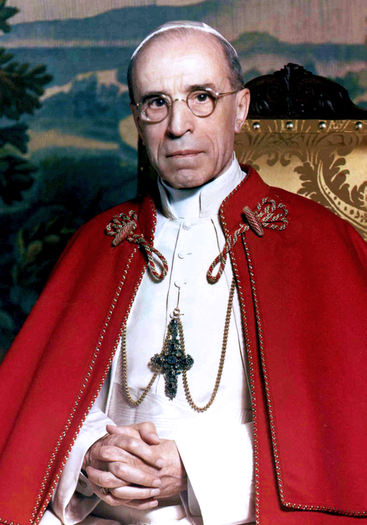
Resta Ora (1955)
Address of His Holiness Pope Pius XII to the Italian Association of Catholic Jurists on Crime, Punishment, and Rehabilitation, February 5, 1955
[The address is the third and final part of a discourse begun under the title Accogliete on Dec. 5, 1954.]
It remains now to speak of the final section of the path which We wished to point out to you, that is, the return from the state of guilt and punishment to that of liberation.
Liberation from guilt and liberation from punishment are not necessarily identified, either in concept or in reality. Prescinding from the fact that, in the sight of God, the remission of eternal punishment is always connected with the remission of grave guilt—guilt may be remitted without necessarily implying the extinguishing of the penalty. On the other hand, the penalty may have been paid without the guilt having ceased to exist in the inner being of the culprit.
Now, the return to the juridical and ethical order consists essentially in the liberation from guilt, and not from punishment.
1. LIBERATION FROM GUILT
In the exposition of the first section of this path (cf. Osservatore Romano, 6-7 Dec., 1954), We pointed out the internal and external character of the guilty act, that is, in relation to its author, as also in its relations to higher authority, which is, in the last analysis, the authority of God Himself, Whose majesty, justice and holiness are slighted and offended in every culpable act.
In what does liberation from guilt consist…
Liberation from guilt must, therefore, reintegrate the relations disturbed by the culpable act. If we are dealing with a simple real debt, that is, one that is concerned with purely material considerations, it may be fully extinguished by the handing over of the thing required, without the necessity of any personal contact with the other party. If, however, there is question of a personal offense (either by itself or connected with a real debt), then the culprit is bound to an obligation, in the strict sense, to the person of the creditor. It is from this strict obligation that he must be released. And because, as We have already said, this obligation has a psychological, juridical, moral and religious aspect, so his liberation must have a similar aspect.
Guilt, however, in its internal element, also implies in the culprit a state of enslavement and of bondage on his part to the object to which he has given himself in the performance of the culpable act; that is, in substance, an enslavement to a pseudo-ego whose tendencies, impulses and ends constitute in man a caricature of the genuine ego, intended by the Creator and by nature only for the good and the true. This contradicts those norms of the right path according to whose direction man, made in the image of God, should act and form himself. From this enslavement also must there be effected a psychological, juridical, moral and religious liberation.
In human law, we may speak of a sort of liberation from guilt, when the public authority no longer proceeds against the culpable act; for example, even without regard to the actual internal dispositions of the culprit, by positive remission of the guilt on the part of authority, or because there has expired the period established by the law, within which exclusively the same authority intends, under certain conditions, to bring before its tribunal, and to pass judgment upon, the violation of the law that has taken place. However, this way does not constitute an interior conversion, a metanoia, a liberation of the ego from its interior slavery, from its will to evil and to illegality. Now, it is only to this liberation from guilt in its proper meaning, to this metanoia (that is, change of mental attitude), that We would wish here to draw attention.
Psychologically
Psychologically considered, the liberation from guilt is the abandonment and retraction of the perverse will freely and consciously placed by the ego in the culpable act, and the renewed intention to will what is right and good. This change of will presupposes a return into oneself, and hence an understanding of the evil and culpability of the resolution formerly taken against the good recognized as obligatory. There is united to such understanding the reprobation of the evil done, repentance as directly willed sorrow, deliberate regretfulness in the soul for the evil perpetrated because it was wicked, contrary to law, and, in fine, contrary to God. In this katharsis of the inner being, there is also accomplished and included a withdrawing from the false good to which man had turned in his guilty act. The culprit begins to submit himself to the order of justice and right, in obedience to its author and guardian, against whom he had rebelled.
This leads psychologically to the final step. Since the culpable act—as already mentioned—is not the offense directed against an abstract norm of law, but is, in substance, a stand against the person of the obligating or prohibiting authority, complete conversion tends, through psychological necessity in one form or another, toward the person of the offended authority with the explicit or implicit sorrowful confession of the fault, and with interior petition for remission and pardon. Holy Scripture gives us brief and classic examples of such repentance, like the words of the publican in the Temple: “Deus, propitius esto mihi peccatori”—O God, be merciful to me the sinner! (Luke 18, 13) or the words of the prodigal son: “Pater, peccavi”—Father, I have sinned (Luke 15, 21).
Not mere suppression
In spite of this, when considered under the purely psychological aspect, the perverse will expressed in the culpable act can end in another way without attaining release from guilt. The culprit no longer thinks of his act, but he has not actually retracted it; it has simply ceased to weigh upon his conscience. Now, it should be clearly stated that such a psychological process does not constitute a release from guilt, just as falling asleep in the evening does not signify or obtain the removal, much less the suppression, of the evil committed during the day. Nowadays, some will perhaps say that the guilt has been submerged in the subconscious or the unconscious. But it is still there.
Nor would any better result be obtained with the attempt to suppress the psychological awareness of guilt by means of auto-suggestion or external suggestion, or even by means of clinical psychotherapy, of psychoanalysis. A real, free, guilty will cannot be psychologically corrected or suppressed by insinuating the persuasion that it has never existed. We have indicated the deplorable consequences of a like treatment of the question of guilt, in the discourse addressed to the members of the Fifth International Congress of Psychotherapy and Clinical Psychology [Nous Vous Souhaitons], April 15, 1953 (cf. Discorsi e Radiomessaggi, Vol. XV, pp. 67 ff.).
May be lengthy process
A final observation must yet be made on this question of psychological liberation from guilt. A single, fully conscious and free act can contain all the psychic elements of a true conversion; but its depth, firmness and extent can present defects which, if not essential, are at least appreciable. A profound, extended and lasting liberation from guilt is often a lengthy process which only gradually reaches maturity, particularly if the culpable act has been the fruit of an habitual disposition of the will. The psychology of relapses offers more than sufficient material for proof on this point, and the supporters of the purifying, educative and fortifying function of a somewhat lengthy imprisonment find in these experiences a confirmation of their theory.
Juridically
Juridical liberation from guilt, as distinct from the psychological conversion that is accomplished in the intimate will of the culprit, is directed essentially to the higher authority, whose requirements for observance of established norms have been slighted or violated. Private violations of legal rights, if they have occurred in good faith or otherwise do not prejudice the common good, are settled privately between the parties or by means of a civil action. They are not ordinarily the object of penal law.
In the analysis of the culpable act, We have already pointed out that it constitutes the withdrawal and the negation of due subordination, due service, due devotion, due respect and homage; that it is objectively an offense against the loftiness and majesty of the law, or rather of the law’s author, guardian, judge and vindicator. The exigencies of justice, and hence juridical liberation from guilt, require that as much service, subordination, devotion, homage and honor be restored to authority as were taken from that authority by the delict.
Free or forced
This satisfaction may be performed freely; it may also, in the suffering endured because of the penalty inflicted, be to a certain degree forced; it may at one and the same time be forced and free. Law in modern nations does not attach much importance to voluntary reparation. It is content to have the will of the culprit, by means of the penalty suffered, submit to the powerful will of public authority, and to reeducate his will in this way to work, to social relations, to right action. It is not to be denied that such a method of procedure can, by reason of immanent psychological laws, lead to an interior reform, and hence to an interior liberation from guilt. But that this must happen, or regularly does happen, is still to be demonstrated. In any event, not to take into consideration, as a matter of principle, the will of the culprit to give satisfaction insofar as sound juridical sense and violated justice require, is a deficiency and a lacuna, the bridging of which is earnestly demanded by the interests of doctrine, and of fidelity to the fundamental principles of penal law.
If adequate reparation is impossible…
However, juridical liberation from guilt comprises not only the will to perform the required reparation but the actual reparation itself. Here science and the circumstances of concrete life are frequently confronted by a difficult question: what should be the rule in the event of moral or physical inability to perform such reparation? Must we recur to a sort of compensation or substitution, or may the exigencies of violated law be left without reparation? We have already indicated that man, by means of a culpable act committed with full responsibility, is capable of offending or of destroying certain goods and juridical obligations; but after the fact he is often no longer in a position to provide adequate satisfaction. This is true in the instance of murder, of privation of sight, of mutilation, of full sexual violation, of adultery, of definitive destruction of another’s good name, of the declaration of an unjust war, of the betrayal of state secrets, of certain forms of lèse majesté, and of other like delicts.
The law of retaliation would inflict a proportionate evil on the culprit. However, by this alone, the one injured in his rights would not receive reparation nor have his rights restored. But, prescinding from the fact that adequate indemnity is not impossible in all cases, it should be noted that judgment on the guilt regards not so much the damaged good of the other party, but principally the person of the culprit and his perverse will exercised to his own advantage. In opposition to this is the offering or reparation made by the culprit at his own expense, from his personal being, property and ability, for the benefit of another, that is, in every case, of the violated law, namely, of the superior authority. Thus active reparation which includes the interior conversion of the will, is for the culprit who at his own expense performs the required satisfaction, the second of the two above-indicated elements which constitute liberation from guilt. The same cannot be said of purely passive reparation when the culprit is forced to bow beneath the suffering that this reparation implies. This purely passive satisfaction, from which any element of voluntary and repentant will is lacking, is thus deprived of the essential element of liberation from guilt. Consequently, the culprit remains in his culpable condition.
Infinite abyss and its Bridge
We have many times pointed out that every grave culpable act is in the last analysis an offense before God Who has an absolute, because divine, right to obedience and submission, to service and praise, and Who as Author, Guardian, Judge and Avenger of the juridical order, makes known to the culprit His exigencies with that unconditional absoluteness which is proper to the intimate manifestations of conscience. In the guilty resolution of the ego, man slights God Who thus reveals Himself, he leaves aside the infinite good, the absolute majesty, and in this way places himself by his action above God. But if man repents and returns to his proper subordination before the majesty of God, if, in conscious and complete surrender of his ego to the supreme infinite good, he separates himself from his culpable act in its deepest roots in order once again to be free in good and in his God, he nevertheless finds it impossible to make reparation by his own powers (that is, as derived from his own being, will and potency) in any proportionate fashion for that which he has committed in the sight of God by his act. He has offended and slighted an absolutely infinite good, an absolutely unlimited right, a supreme majesty. In the gravity of his fault there thus intervenes this absolute infinity, while anything that man might offer or actuate is essentially, intensively and extensively, finite. Even were such reparation to endure until the end of time, it can never reach a stage of equality—tantum quantum—between the exigency of God and the offering or reparation of man.
God has bridged this abyss; He has put into the hands of finite man an infinite price; He has accepted as an offering of reparation for guilty man the ransom offered by Christ which is super-abundant, because it is of infinite value in submission, honor, and glorification, by reason of its derivation from the hypostatic union. As long as time will endure, this ransom remits for repentant man his guilt before God through the merits of Jesus Christ.
Science and religion
Let it not be said that these theological and religious considerations lie outside the field and the interests of science and juridical practice. Doubtless a sharp distinction of competencies is an advantage to life and to any true science; but in this self-limitation one must not reach the point of denying or ignoring explicitly inseparable connections which by intrinsic necessity are manifested on every side. In every real offense—in whatever material field it may have taken place—there is contained a relation with the ultimate requirement of all law and of all order. It is a characteristic or prerogative of the world of law that there is nothing in it which in its fundamental structure has been created without this supreme requirement, or which in its final analysis can be made intelligible without this transcendent relation. In this there is no debasement, but rather an elevation of law and of juridical science, for which total laicization is an impoverishment, not an enrichment.
The ancient Romans united law and right (ius ac fas), notwithstanding the difference in concepts, and they always conceived them as related to the divinity. If now modern depth-psychology is correct, there is in the innate dynamisms of the subconscious and the unconscious a tendency which draws toward the Transcendent and makes the essence of the soul gravitate toward God. The analysis of the guilt-process and of liberation from guilt reveals the same tendency toward the Transcendent. This analysis brings forward considerations and aspects which the science and practice of penal law do not of course have to treat of directly, but about which they should have sufficient knowledge in order that others may make them useful to the end of the execution of the penalty and apply them to the advantage of the culprit.
Morally
Moral liberation from guilt coincides substantially for the most part with what We have already said concerning psychological and juridical liberation. It is the reprobation and withdrawal of the positive contempt and violation of the moral order committed by the culpable act; it is the conscious and voluntary return of the penitent culprit to submission and conformity with the ethical order and its obligatory requirements. There are comprised in these positive acts the endeavor and the offering of the guilty one to satisfy the just demands of violated law of the ethical order, or, better, of the author, Lord, guardian and vindicator of that order. And there appears the conscious will and resolution of the culprit to be faithful in future to the precepts of what is right and good. In its essential parts, then, this liberation consists in that interior disposition which has been indicated in the statement presented by you as the purpose and the fruit of the right fulfillment of the penalty, even though it is here considered and circumscribed under a slightly different viewpoint.
Religiously
Lastly the religious aspect of liberation from moral guilt demands a freeing of the soul from that internal guilt under which the culprit stands in the sight of God, who is the Supreme and Final Judge of all law, and of every moral obligation. By reason of His infinity He upholds every law which proceeds from the Divine Will, whether it be promulgated by Him directly or through the instrumentality of some duly constituted human authority acting within the sphere of its legitimate jurisdiction.
How man can free himself or be freed from his offense against God has been already sufficiently explained in the second point concerning the juridical aspect. But if this final religious deliverance is not manifested to the culprit, or at least if the way to such is not pointed out or made smooth—if only by means of a long and severe penalty—then in such a case very little, not to say nothing, is offered to guilty “man” in his punishment, however much one may talk of psychic cure, of re-education, of social formation of the person, or emancipation from aberrations and from enslavement to himself.
Doubtless these expressions mean something that is good and important; but for all that, man remains in his guilt before the Supreme Judge, upon Whom his final destiny depends. This Judge can and often does wait for a long time, but in the end He consigns the culprit to the guilt from which he is unwilling to desist and to the consequences of that guilt. It is indeed sorrowful to have to say about a man: “bonum erat ei, si natus non fuisset homo ille” (St. Matthew 26, 24): “It were better for that man if he had not been born.”
Therefore, if someone or something can contribute toward warding off such an evil, even though it be penal law or the execution of a lawful penalty, no effort should be spared. This is particularly true because God, during this life, is always most willing to effect a reconciliation. He incites man to accomplish internally the psychic withdrawal from his senseless act; He offers to welcome him once again if he repents, into His friendship and His love. It is to be hoped that human penal law in its judgment and the execution of its judgment will never lose sight of the human personality of the culprit and will ever seek to strengthen that human personality and assist it to return to God.
2. LIBERATION FROM THE PENALTY
The return from the state of guilt and of punishment necessarily includes liberation not only from the guilt, but also from the penalty; only thus is there obtained that “restitutio in integrum,” as it were, a restitution to the original state or condition of non-culpability and hence of non-penalty.
Eternal punishment in the divine law
Recent facts and statements suggest to Us at this point a brief declaration. Not every penalty that is incurred bears within itself its own remission. Revelation and the teaching authority of the Church establish clearly that, after the end of this earthly life, those who are burdened with grave guilt will receive from the Most High God a judgment and an execution of penalty from which there is no liberation or condonation. God could, in the next life, also remit such a punishment; everything depends on His free will; but He has never granted it and will never do so. There is no point in discussing here whether this fact can be established with certainty by the force of reason alone—as some assert, while others consider it doubtful. But both opinions contain, in their arguments based on reason, considerations which indicate that such a divine disposition is in no way contrary to any of God’s attributes: neither to His justice or His wisdom, neither to His mercy or His goodness. Furthermore these considerations show that the divine disposition is by no means opposed to the human nature bestowed by the same Creator, with its absolute metaphysical finality directed to God, with the impulse of the human will toward God, with the physical liberty of the will rooted and ever permanent in created man.
All these reflections may perhaps leave in man, when he makes his judgments relying on his own reason alone, a final question, not so much about the possibility, but rather about the reality of such an inflexible decree of the Supreme Judge. Hence, it will not arouse too much astonishment if a noted theologian could write, at the beginning of the seventeenth century: “There are four mysteries of our most holy Faith which are most difficult for the human mind to believe: the mystery of the Trinity, of the Incarnation, of the Eucharist, and of eternal punishment” (Lessius, De Perfectionibus moribusque divinis, lib. XIII, cap. XXV). Nevertheless, the fact of the immutability and the eternity of that judgment of reprobation and of its fulfillment is beyond dispute. The discussions which have arisen because of a recently published book (Giovanni Papini, Il Diavolo; Vallecchi, 1954) frequently portray a grave lack of understanding of Catholic doctrine, and they are founded on premises that are either false or falsely understood. In the present instance the Supreme Legislator, in the use of His sovereign and absolute power, has established the unending validity of His judgment and of its execution. Hence, this limitless duration is the law now in force.
Various forms of cessation of punishment in human law
But let us now turn to the field of human law, which is the principal object of the present discourse. As We have already indicated, liberation from guilt and liberation from punishment do not always coincide. The guilt may come to an end and the penalty continue, and then on the other hand, the guilt may continue in force while the penalty terminates.
There are various forms of cessation of punishment. It is first of all clear that such cessation is reached automatically at the moment in which the penalty inflicted has been paid, or when the period of time originally set down has been passed, or else when its continuance (sometimes its very execution) was connected with a condition, either resolutory or suspensive, and this condition has been sufficiently fulfilled.
The remission of the penalty
Remission is another form of cessation of the penalty, by means of an act of the competent higher authority. This may take the form of a favor, an indult or an amnesty, which is somewhat analogous, in the field of religion, to the “indulgence.” The power to issue such acts of clemency does not rest with the judge who has pronounced the sentence of condemnation, applying to the individual case the penalty established in law. Per se, it resides with the power that judges and punishes in its own name and in virtue of its own law. Hence, the right to remit the penalty avails ordinarily in the life of the state as something reserved to the supreme authority. That authority can exercise this right by means of a general decree or by one concerned with an individual case.
Certain favors or mitigations in the execution of the penalty, which leave its substance unchanged, but which are granted to the culprit by reason of good conduct or for other motives, are not included under the heading of remission or condonation. Besides, remission of the penalty in the proper sense is applied both to “medicinal penalties” and also to “vindictive penalties” where these latter are admitted.
The final stage of man’s road through guilt and punishment leads anew to the problem, already mentioned several times, of the highest aim or object of the penalty, and particularly about the sense, or according to some, the non-sense, of a purely vindictive penalty.
Medicinal and vindictive penalties
In Our discourse of October 3, 1953, to the 6th International Congress of Penal Law (Discorsi e Radiomessaggi, vol. XV, pag. 352), and also on the present occasion (Osservatore Romano, 6-7 December 1954), We called attention to the fact that many, perhaps the majority, of civil jurists reject vindictive punishment. We noted, however, that perhaps the considerations and arguments adduced as proof were being given a greater importance and force than they have in reality. We also pointed out that the Church in her theory and practice has maintained this double type of penalty (medicinal and vindictive), and that this is more in conformity with what the sources of revelation and traditional doctrine teach regarding the coercive power of legitimate human authority.
It is not a sufficient reply to this assertion to say that the aforementioned sources contain only thoughts which correspond to the historic circumstances and to the culture of the time, and that a general and abiding validity cannot therefore be attributed to them. The reason is that the words of the sources and of the living teaching power do not refer to the specific content of individual juridical prescriptions or rules of action (cf. particularly Rom. 13, 4), but rather to the essential foundation itself of penal power and of its immanent finality. This, in turn, is as little determined by the conditions of time and culture as the nature of man and the human society decreed by nature itself. But, whatever the attitude of positive human law on this problem, it is sufficient for Our present purpose to make clear that in any total or partial remission of punishment the vindictive penalties (no less than the medicinal) can and even should be taken into consideration.
Exterior element
Arbitrariness cannot prevail in the application of condonation. The good of the culprit, no less than that of the juridical community whose law he has culpably violated, must serve as a norm. Above both of these are the respect and excellence of the order established according to what is good and righteous. This norm requires, among other things, that, as is the case in the normal relations of men with one another, so also in the application of penal power, there be considered not only strict law and justice, but also equity, goodness, and mercy. Otherwise there is danger that the summum ius be converted into summa iniuria. It is precisely this reflection which gives rise to the thought that, in medicinal penalties, and also, within certain limits, in vindictive penalties, a remission of the punishment should be taken under consideration whenever there is moral certainty that the inherent purpose of the penalty has been obtained, that is, the true interior conversion of the guilty person, and a serious guarantee of its lasting character. The regulations of Canon Law in this matter (cf. Canon 2248, paragraphs 1 and 2, and Canon 2242, paragraph 3, of the Code of Canon Law) might serve as a model. These require, on the one hand, proof of the actual change of mental attitude in the culprit, and, on the other, do not provide for any automatic condonation, but rather make it depend on a positive juridical act of the competent authority. In the memorial presented by you, it is stated that civil penal law on this point makes a new development and a more elastic adaptation to just, modern exigencies appear desirable. This proposal may be good, although the requirements of civil penal law under various aspects differ from ecclesiastical penal law. In any event, the carrying out of any reform seems to require new theoretical clarifications and well-founded practical experimentation.
Interior element of liberation from punishment
Along with the legal and technical aspect of liberation from punishment, the same memorial also mentions another, completely different, but very real influence, which is exerted upon the culprit, and which, being a more profound, intimate liberation from punishment, cannot be passed over in silence. Naturally it is less pleasing to professional jurists as such, although acceptable to them as “men” and “Christians”; it indicates an essential deepening or, one may prefer to say, a sublimation or “Christianization” of the entire problem of the execution of penalties.
The example of innocent persons condemned
Punishment is looked upon, by its very nature, as an evil imposed on man against his will; hence it creates of itself a spontaneous defensive attitude on the part of the interior man. He feels himself robbed of the free disposition of himself and subjected to an extraneous will. Similar evils, but arising from other sources, frequently affect man, or he may even choose them by his own free election. As soon as spontaneous opposition to the suffering no longer exists, its oppressive and humiliating aspect disappears or is substantially diminished, even though the sensitive and painful element remains. This We have already had occasion to point out in the second part of Our present exposition. Very many people, even though innocent, are today thus oppressed and suffering; they suffer physically and morally in prisons and penitentiaries, in concentration camps, in places of forced labor, in mines, in quarries to which they have been relegated by political passion or the arbitrary whim of totalitarian powers. They suffer all the miseries and all the sorrows—and sometimes even more—that can be inflicted upon true culprits according to law and justice. Those who through no fault of their own suffer such evils are certainly not able to escape externally the pressure of force, but they can interiorly rise above all such things, sustained perhaps by naturally good moral motives, but much more easily and effectively by religious considerations, by the certainty that always and everywhere they depend on Divine Providence which permits no person or thing to be taken from its grasp, and which—beyond the fleeting period of man’s earthly life—possesses an eternity and an almighty power to set aright whatever has been unjustly suffered, to equalize again all things disarranged and hidden, to crush and punish all human tyranny. To the eyes of the Christian, there is ever present Our Lord, Who in His Passion experienced all the depths of human suffering and tasted all its bitterness, and, in obedience to the Father, for love of Him and out of loving compassion for men, willingly took upon Himself sorrow and ignominy, the cross and death. Strengthened by the example of the God-man, many of these innocent victims find in their suffering interior liberty and peace, and attain an interior liberation from sorrow, even while the external affliction endures, through the way of faith, of love and of grace.
Charitable work of assistance to the condemned
Those who suffer through their own fault and feel themselves slaves of punishment may also attain the same end and by the very same way. We would wish to recall here what We have already said when speaking of the execution of punishment, concerning the spiritual circumstances of the person condemned to prison. Here We desire to consider how one can and should assist him to attain an interior victory and consequently an interior liberation from the evil of punishment. By faith and love and grace, clarity of vision and light can be imparted to his spirit, warmth and substance to his courage, strength and support to his weakness. Unquestionably the convicted person could himself bring to maturity and completion such an elevation; few, however, abandoned to their own devices, will be able to do so. They therefore need from others advice, assistance, sympathy, encouragement and comfort. But the one who undertakes such a task must draw forth from his own convictions and his own interior riches that which he would communicate to the prisoner. Otherwise his words would be only sounding brass and tinkling symbals (I Cor. 13, 1).
“For one of these…”
We have read with profound emotion what one of your members, the distinguished Professor Francesco Carnelutti, has written on the words which the Lord will pronounce at the end of time: “I was in prison and you visited me…. As long as you did it for one of these the least of my brethren, you did it for me” (Matt. 25, 36-40). What is here proposed as the ideal in the gift of oneself for the spiritual salvation and purification of the prisoner goes beyond the new precept of the Divine Redeemer “Love one another,” which was to be the evident mark whereby His disciples would recognize one another (John 13, 34-35); it is a question, in fact, of approaching the guilty one in such wise as to see, honor and love him in the Lord, and even so to liken oneself to him as to put oneself spiritually in the place of the man in convict’s garb and detained in his prison cell, as the Lord says of Himself: “I was in prison and you came to me” (Matt. 25, 36): all of this interior world, this light, and this goodness of Christ can give the condemned prisoner support and assistance in order to come forth from the wretched servitude of punishment and acquire once again liberty and interior peace.
Contribution of the community to deliverance
Furthermore the words of the Lord place an obligation not only on those who have the immediate care of the condemned person, but also on the community itself of which he is and remains a member. The community should see to it that it is disposed to welcome lovingly the man who comes forth from prison into liberty. This love should not be blind but clearseeing, and at the same time sincere, helpful and discreet, such as to make possible his re-adaptation to social life and a renewed consciousness of himself as free from guilt and punishment. The requirements of such a disposition are not based upon a utopian blindness to reality. As has been noted, not all criminals are ready and inclined to bear with the required process of purification—and perhaps the percentage of such is rather large—but it is still true that many others can be, and are assisted to obtain complete interior liberation, and for these especially no Christian effort will ever be too much or too difficult.
May these considerations of Ours contribute with the richness of Christian thought toward illuminating the true meaning, morally and religiously purified, of punishment, and with the outpouring of charitable assistance, may they help to make smooth for the condemned prisoner the way that must lead him to the longed-for liberation from guilt and punishment.
With such sentiments We ask God to bestow upon you, gentlemen, and upon your lofty and meritorious work the choicest and most abundant heavenly favors, while from Our heart We impart to you Our paternal Apostolic Blessing.
[Original Source (Italian): Acta Apostolicae Sedis, vol. 47 (1955): pp. 72-85. Translation Source: The Pope Speaks, vol. 2, no. 1 (1st qtr., 1955), pp. 27-39; italics and bold print given.]
Image source: Wikimedia Commons
License: public domain

 ;