
Naturalist twaddle with a supernatural veneer…
Heresy Meets Inanity:
Leo XIV’s Bizarre Interreligious Speech in Buenos Aires
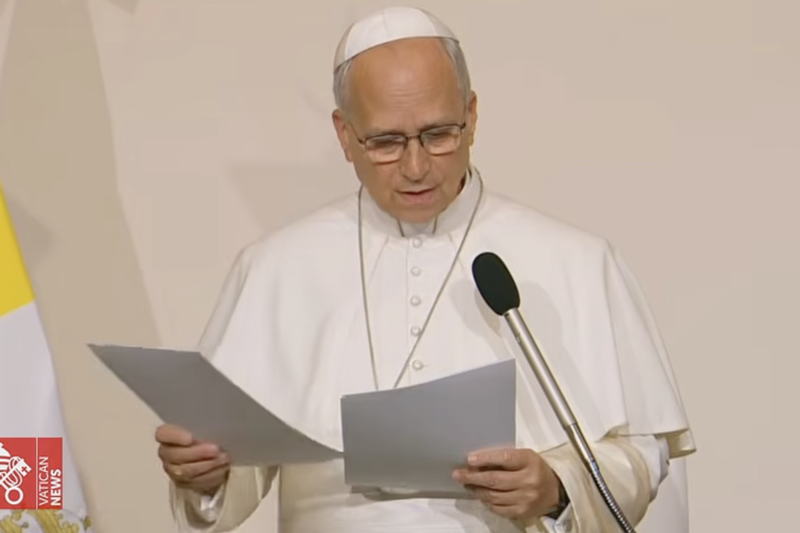
Robert Francis Prevost, better known by his pseudonym ‘Pope Leo XIV’, is currently on a blather tour through Uruguay, Argentina, and Peru.
Officially marketed as an ‘Apostolic Journey’, it is, of course, nothing of the kind. Indeed, the very people there who need to hear the Gospel the most are instead being presented with a woeful mix of Naturalist, Indifferentist, and Masonic drivel. In this regard, Leo is no different from his inglorious predecessor Jorge Bergoglio (‘Pope Francis’), even though he is much different from him in terms of style and personality.
Leo is currently in Argentina, the second leg of his 12-day trip. In particular, he is in Buenos Aires, the very place which was Francis’ home town and which the latter avoided visiting like the plague. Although various reasons/excuses were given, the most likely scenario is that he knew or feared that he would not be received well at home, where people knew him best.
One of the addresses Leo XIV gave on Nov. 9, 2026, was at the so-called “Meeting With the Leaders of Christian Communities and Religious Traditions” at the Palacio San Martín in Buenos Aires. The audience included members of various religions, including Jews and Moslems.
Instead of preaching the Gospel to the unbelieving ears, however, Leo offered an apostatical interreligious message that clearly communicated that all religions are fundamentally good and acceptable to God. In fact, the discourse was so dreadful that it could have been written by Bergoglio himself.
Before we dissect the text, here is the video made available by Vatican News:
.
A report on the meeting was also published:
We will now go ahead and look at some of the worst portions of the address. The full text can be found here.
Prevost begins by telling everyone what he believes, at least supposedly, and then makes the other feel welcome:
I am here among you as the Successor of the Apostle Peter, and as I profess with him faith in Christ, “the Son of the living God” (Mt 16:16), true God and true man, I acknowledge the baptismal unity with our brothers and sisters of the Christian confessions. In accordance with the teachings of the Second Vatican Council, I wish to reaffirm the spiritual ties that unite the Church to the Jewish people (cf. Nostra Aetate, 4) and our sincere respect for whatever is holy and true in the different religious traditions (cf. ibid., 2).
There will not be lacking those who will claim that Leo was giving profound witness to Christ with these words, whereas in actual fact what he was merely providing for himself an alibi of sorts before validating everyone else’s respective religions.
Since Leo claims to be the successor of St. Peter, perhaps we should take a look at how St. Peter preached to unbelievers:
Ye men of Israel, hear these words: Jesus of Nazareth, a man approved of God among you, by miracles, and wonders, and signs, which God did by him, in the midst of you, as you also know: This same being delivered up, by the determinate counsel and foreknowledge of God, you by the hands of wicked men have crucified and slain. Whom God hath raised up, having loosed the sorrows of hell, as it was impossible that he should be holden by it. For David saith concerning him: I foresaw the Lord before my face: because he is at my right hand, that I may not be moved. For this my heart hath been glad, and my tongue hath rejoiced: moreover my flesh also shall rest in hope. Because thou wilt not leave my soul in hell, nor suffer thy Holy One to see corruption. Thou hast made known to me the ways of life: thou shalt make me full of joy with thy countenance. Ye men, brethren, let me freely speak to you of the patriarch David; that he died, and was buried; and his sepulchre is with us to this present day. Whereas therefore he was a prophet, and knew that God hath sworn to him with an oath, that of the fruit of his loins one should sit upon his throne. Foreseeing this, he spoke of the resurrection of Christ. For neither was he left in hell, neither did his flesh see corruption. This Jesus hath God raised again, whereof all we are witnesses. Being exalted therefore by the right hand of God, and having received of the Father the promise of the Holy Ghost, he hath poured forth this which you see and hear. For David ascended not into heaven; but he himself said: The Lord said to my Lord, sit thou on my right hand, until I make thy enemies thy footstool. Therefore let all the house of Israel know most certainly, that God hath made both Lord and Christ, this same Jesus, whom you have crucified.
Now when they had heard these things, they had compunction in their heart, and said to Peter, and to the rest of the apostles: What shall we do, men and brethren?
But Peter said to them: Do penance, and be baptized every one of you in the name of Jesus Christ, for the remission of your sins: and you shall receive the gift of the Holy Ghost. For the promise is to you, and to your children, and to all that are far off, whomsoever the Lord our God shall call.
And with very many other words did he testify and exhort them, saying: Save yourselves from this perverse generation.
(Acts of the Apostles 2:22-40)
Needless to say, this is not the message Leo XIV had for Argentinian unbelievers.
As if God were indifferent to truth and falsehood, right and wrong, good and bad, Leo presents religions as vehicles “to share cultural values and good works.” He then reflects on prayer as an action the different religions all have in common:
In the various religions, people pray raising their voices to God. In keeping with our respective traditions, countless languages, songs and gestures converge heavenward, as though gathering before the ineffable mystery of our existence (cf. Nostra Aetate, 1).
Here the false pope presents the prayer of all religions as being essentially the same, or at least equal, for he makes no distinction between the prayer of one religion and another. With his reference to the outrageous Vatican II declaration Nostra Aetate, Prevost even includes Hinduism and Buddhism in his remarks, both of which are explicitly mentioned in the conciliar document.
Leo puts the prayer of the true religion on the same level as the (objectively) odious and vain prayers of false religions (cf. 3 Kgs 18:20-40; Mt 6:7; Mk 7:7). To make this more palatable, notice how he speaks smoothly of the different religions as merely being “our respective traditions”, as if we were talking about differences in cuisine, clothing, or leisurely activities. However gently and gradually, the leaders of the Vatican II Church have been trying to inculcate in souls the idea that, ultimately, all religions worship the same true God. No one did it more brazenly than ‘Pope’ Francis in Singapore in 2024.
Throughout the remainder of his speech, Prevost elaborates on “three aspects that emerge from sincere prayer, in which our beliefs find a voice: religions as guardians of human dignity, religions as expressions of our freedom, and religions as places in which to cultivate hope.”
The fake pope then proceeds to explain how, supposedly, “religions safeguard human dignity” (note the plural: religions). But his words are obscure and his reasoning appears contrived. One gets the impression he is trying hard to arrive at a pre-conceived conclusion. We will quote the entire passage to demonstrate how abstruse it is:
First of all, every religion bears witness to the fact that the human person is defined by need and desire: we are all yearning for life. Our lungs seek air as our conscience seeks goodness. Every day we seek water as we seek truth; we need nourishment as we need justice. In this regard, religions remind everyone that we are made of more than matter. Indeed, our very flesh bears the imprint of an abundance of life and meaning. This same desire, which becomes a cry and a plea, bears witness to the fact that we do not come from nothing and were not made for death. In this way, then, religions safeguard human dignity. In prayer, which expresses our faith, the ideals of goodness and justice, health and peace are not empty words to be filled with selfish interests, but testimonies to our common will, which is directed toward joy. Whenever we pray, therefore, we must care for those who live alongside us, making the words we utter authentic through renewed fraternity. As we praise God for the gift of life, let us defend it, always and for everyone, from conception to its natural end, especially when it is threatened by poverty and violence. In this way religions promote the dignity of every man and woman in the family, in education, in work and in the environment.
This just doesn’t make a whole lot of sense.
When we pray, goodness, justice, health, and peace are “testimonies to our common will, which is directed toward joy”? And therefore “we must care for those who live alongside us”? Did the mediocre Argentinian thinker ‘Cardinal’ Victor Manuel Fernandez perhaps prepare Leo’s speech?
Of course it is easy to claim all religions promote human dignity, especially when this is something everybody likes to hear. But what about evidence that contradicts that notion?
For example, exactly how do Hindu cow dung fights bear witness to the dignity of man? Or the barbaric Sharia of Islam? Or the Jewish Talmud, which says, “If one defecates in an open place in which there are no partitions, he should orient himself to face south with his back to the north, or vice versa. However, east-west is forbidden” (Shulchan Arukh, Orach Chayim 3:5)?
Only the Catholic religion teaches the true dignity of man (and those ‘Christian’ sects that have chosen to retain the Catholic teaching in this regard):
When the faithful have placed these things before their eyes, let them also reflect that God condescended to assume the lowliness and frailty of our flesh in order to exalt man to the highest degree of dignity. This single reflection, that He who is true and perfect God became man, supplies sufficient proof of the exalted dignity conferred on the human race by the divine bounty; since we may now glory that the Son of God is bone of our bone, and flesh of our flesh, a privilege not given to Angels, for nowhere, says the Apostle, doth he take hold of the Angels: but of the seed of Abraham he taketh hold.
(Catechism of the Council of Trent, Part I, Article III)
But then, one must also ask: Why is it that the Vatican II religion continually appeals to human dignity as the ultimate standard of conduct? What about the law of God?
Leo XIV’s strange address continues. Having spoken about dignity, the American pseudo-pontiff considers freedom next:
Second, when human beings speak to God, they know that they themselves are not God. We did not make the earth. So let us not destroy with our own hands the “garden” that the Creator has entrusted to us! In this regard, insofar as religions safeguard the wisdom of peoples, they build up society, educate consciences and free us from idols: the idol of domination, because we are not the god of others; the idol of vainglory, because the things we possess do not make us divine; and the idol of war, because there is only one Lord and Judge of history. He continually gives us life and cares for all peoples. The true name of his power is love, a love that knows no end. As we praise God for the gift of salvation, let us commit ourselves to being a sign of this gift for the world. In this way, religions give the fullest expression to our freedom.
This is simply a head-scratcher.
But the address goes from simply being bizarre to being heretical because Prevost is addressing a multi-religious audience when he says, “As we praise God for the gift of salvation, let us commit ourselves to being a sign of this gift for the world. In this way, religions give the fullest expression to our freedom.”
In other words, salvation can be found in any religion, and religious people ought to manifest this salvation to those who are not yet religious. So much for proclaiming Christ, right?!

Alas, we have not reached the end yet. The tripe keeps on going, and again we can do no better than simply to quote it:
Third, when human beings speak to God, they open themselves to the future. Yes, the future is the time of faith. Religions are a bond between generations, an age-old memory, prophecy, expectation and promise. That is why believers always look to the future with hope. When the light of faith pierces the darkness of death, hope is restored to the future of every man and woman, of society and of the whole world. Our waiting together then becomes productive, because hope encourages us to weave bonds of a good life, which free us from solitude and bring peoples together in harmony. The very word “religion” shows this, for religare means to connect, to bind people to one another. This relationship sustains our journey through history. Therefore, as we praise God for the gift of hope, let us share it with those who suffer in poverty, with those who have lost the meaning of life and with all who wish to commit themselves to renewing the world in justice. Becoming prayer and proclamation, our language is thus transformed into eloquent charity, which inspires every action.
What goes on behind the forehead of someone who can write such inanities? There is nothing Catholic in these words. It is all generic, pseudo-spiritual junk. A Freemason could have written this and, who knows, probably did.
In the above passage, the line between the natural and the supernatural is deliberately being blurred. Naturalist concepts are being promoted, but they are dressed in the language of the supernatural.
For instance, the concept of “hope” is introduced, but since it is applied to religions as such, it is necessarily a false Naturalist hope, not what Catholic theology knows as the supernatural virtue of hope. It is, in other words, a mere optimistic view as regards this present temporal life, not the supernatural hope that is the bridge between Faith and charity and therefore makes salvation possible: “For we are saved by hope” (Rom 8:24).
Similarly, the word “believers” is used, but not in the Catholic sense of people who possess the supernatural virtue of Faith and therefore habitually make acts of Faith in what God has revealed; instead, it is used to refer to adherents of any religion that believe something.
Thus, the assertion that “believers always look to the future with hope” has no Catholic meaning whatsoever. Once we rephrase it to reflect what is actually meant, it will sound more like this: “People who have beliefs always look to this temporal life with optimism.” What a profound ‘papal’ message! Whoop dee do. Is it even true? Probably not, but even if it is, what does it matter? It’s Naturalist twaddle that does nothing for anybody’s soul.
Furthermore, for Leo to say, “When the light of faith pierces the darkness of death, hope is restored to the future of every man and woman, of society and of the whole world”, is incredibly misleading, because these words are only true if by “faith” is meant the supernatural virtue of Faith, which is infused by God into the soul of every true believer, that is, of every Catholic. For only supernatural Faith in what God has revealed, aided by grace and rendered on the grounds that He who cannot lie or be deceived has revealed it, is truly the “light of faith”. Only this kind of Faith can truly “pierce the darkness of death”, which in turn restores hope. Nothing a Jew, Muslim, or pagan may or may not believe can substitute for that.
As usual, Leo’s words are ultimately about “a good life”, that is, a good temporal life, which is why he says next: “Herein lies our service to humanity: to build a better future for all, as we await the blessed fulfilment of history.” This lays bare the post-Catholic Vatican’s defection from the Gospel: They are working not for the salvation of souls but for improving the temporal world, until they have created a ‘heaven on earth’, so to speak. What infernal madness! What apostasy!
Prevost then doubles down on his insufferable Naturalism with these idiotic lines:
We are indeed certain that the more genuinely men and women come to know themselves, caring for their own dignity, the closer they draw to God. Thus, every good word spoken to someone we meet, every good gesture directed toward our neighbor, rises like a prayer ever pleasing to the Author of justice, who invites everyone to peace.
Who needs a Savior, a Redeemer, a Mediator — and His grace — if you can simply work your way to God with politeness, smiles, and caresses? This is textbook heresy!
The Council of Trent could not have been clearer:
For since Christ Jesus Himself as the “head into the members” [Eph. 4:15], and “as the vine into the branches” [John 15:5] continually infuses His virtue into the said justified, a virtue which always precedes their good works, and which accompanies and follows them, and without which they could in no wise be pleasing and meritorious before God, we must believe that to those justified nothing more is wanting from being considered as having satisfied the divine law by those works which have been done in God according to the state of this life, and as having truly merited eternal life to be obtained in its own time (if they shall have departed this life in grace [Rev. 14:13]), since Christ our Lord says: “If anyone shall drink of the water, that I will give him, he shall not thirst forever, but it shall become in him a fountain of water springing up unto life everlasting” [John 4:14]. Thus neither is “our own justice established as our own” from ourselves, nor is the justice of God [Rom. 10:3] “ignored” or repudiated; for that justice which is called ours, because we are justified through its inherence in us, that same is (the justice) of God, because it is infused into us by God through the merit of Christ.
Can. 1. If anyone shall say that man can be justified before God by his own works which are done either by his own natural powers, or through the teaching of the Law, and without divine grace through Christ Jesus: let him be anathema.
Can. 2. If anyone shall say that divine grace through Christ Jesus is given for this only, that man may more easily be able to live justly and merit eternal life, as if by free will without grace he were able to do both, though with difficulty and hardship: let him be anathema.
(Council of Trent, Session 6, Chapter 16, Canons 1 & 2; Denz. 809, 811, 812; underlining added.)
Furthermore, St. Paul writes: “For by him we have access both in one Spirit to the Father” (Eph 2:18). And again: “For there is one God, and one mediator of God and men, the man Christ Jesus: Who gave himself a redemption for all, a testimony in due times” (1 Tim 2:5-6).
It is stunning to see how more and more openly the pseudo-Catholic hierarchs of the Vatican II Church are denying the basics of the Faith.
After quoting ‘Saint’ John Paul II from an address given at the 2002 World Day of Prayer for Peace in Assisi, Leo ends his atrocious speech by quoting his predecessor’s “Prayer to the Creator”, from which any reference to Our Lord Jesus Christ or the Most Holy Trinity is conspicuously absent:
Lord, Father of our human family,
you created all human beings equal in dignity:
pour forth into our hearts a fraternal spirit
and inspire in us a dream of renewed encounter,
dialogue, justice and peace.
Move us to create healthier societies
and a more dignified world,
a world without hunger, poverty, violence and war.
May our hearts be open
to all the peoples and nations of the earth.
May we recognize the goodness and beauty
that you have sown in each of us,
and thus forge bonds of unity, common projects
and shared dreams. Amen.(Fratelli Tutti, “A Prayer to the Creator,” No. 287.)
Whoever can pen such a prayer has not understood anything about the human condition, specifically regarding original sin and its consequences; nor about the Our Beloved Redeemer, the Holy Gospel, and the end for which God has created us.
In this interreligious address at the Palacio San Martín in Buenos Aires, Leo XIV has shown once more that he holds precisely what Pope Pius XI condemned, namely, “that false opinion which considers all religions to be more or less good and praiseworthy, since they all in different ways manifest and signify that sense which is inborn in us all, and by which we are led to God and to the obedient acknowledgment of His rule” (Encyclical Mortalium Animos, n. 2).
Image source: YouTube (screenshot)
License: fair use

 ;
No Comments
Be the first to start a conversation