
Champions Rousseau’s condemned social contract theory…
Leo’s Montevideo Heresy:
Civil Authority Comes From the People
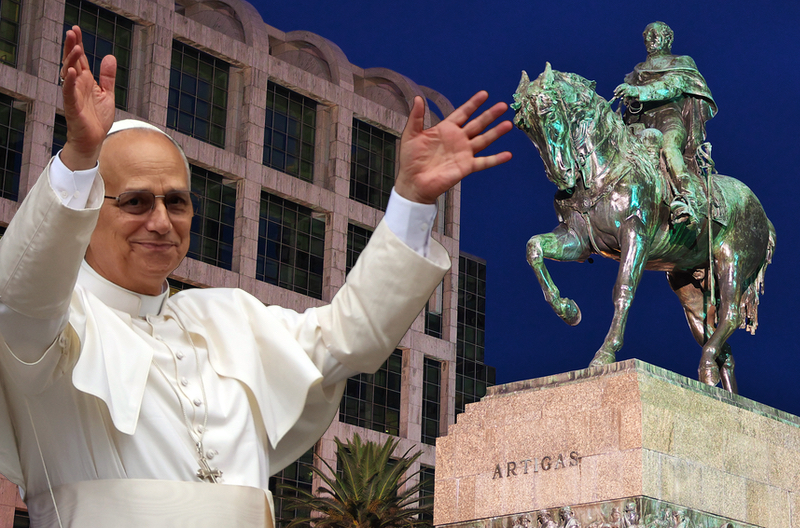
The American Neo-Modernist Robert Prevost, popularly known as ‘Pope’ Leo XIV, has just returned from a 12-day trip to the South American nations of Uruguay, Argentina, and Peru.
In the present post, we want to draw attention to a heresy, or quasi-heresy, which he uttered right on his arrival in Montevideo, the capital of Uruguay, while addressing the nation’s authorities, civil society, and diplomatic corps.
The speech in question was given during a meeting held at the Plaza Independencia, at the center of which is located a statue of Uruguayan hero José Gervasio Artigas (1764-1850) on horseback (see photo below).
Making reference to the “Exodus of the People of the East in 1811, also known as La Redota“, the pseudo-pope stated:
We need not look far to recall it, for the monument to Artigas in the center of this square features on its pedestal a bronze frieze in which Angelo Zanelli depicted scenes from that event. I would like to focus on some details of those figures, since they offer a concrete starting point for reflecting on Uruguay today.
At the top of the monument, Artigas appears alone, on horseback. Further down, on the front relief, he reappears among his men, surrounded by the crowd. This detail brings to mind the words he spoke shortly thereafter before the representatives of the Eastern Provinces gathered at the Congress of April in 1813: “My authority,” he said, “comes from you, and it ceases by your sovereign presence” (Inaugural Address, Artigas Archive, vol. XI, doc. 82). In a single sentence, Artigas spoke of the origin of authority and the responsibility of those who exercise it: authority is received from a specific community and is accountable to that community.
The year 2025 marked four decades of uninterrupted democracy in Uruguay, during which various governments have succeeded one another by the will of the citizens. Public authority finds its raison d’être in service to the common good and is called to exercise it within the framework of law, with respect for the freedom and responsibility of the citizenry (cf. Gaudium et Spes, 74). Hence the value of those structures which allow for participation in public life, which clearly define the powers of institutions, and which provide for the election of those who assume the task of governing (cf. ibid., 75).
(Antipope Leo XIV, Address to Authorities, Civil Society, and Diplomatic Corps, Vatican.va, Nov. 6, 2026; underlining added.)
From the above words it is clear that Leo XIV was not merely neutrally quoting Artigas’ expression of the idea that authority has its origin in the people, but was actually endorsing and advancing it himself.
While this may not raise any eyebrows in the Western world today, the fact remains that this theory — that government arises from the consent of the governed — is contrary to Catholic doctrine. In fact, it is probably heretical because it directly contradicts divine revelation, although it appears that the Church has not labeled it thus: “Every soul must be submissive to its lawful superiors; authority comes from God only, and all authorities that hold sway are of his ordinance. Thus the man who opposes authority is a rebel against the ordinance of God, and rebels secure their own condemnation” (Rom 13:1-2; Knox translation).
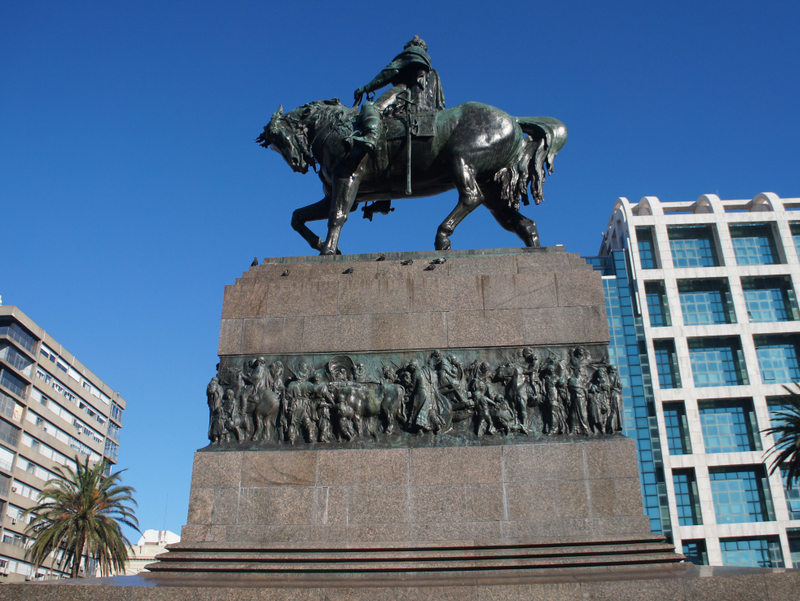 Montevideo, Uruguay: Artigas statue on pedestal with bronze frieze (Shutterstock)
The idea that authority comes from the people instead of God was popularized by the Swiss ‘Enlightenment’ thinker Jean-Jacques Rousseau (1712-1778), whose book The Social Contract, or Principles of Political Right was placed on the Catholic Index of Forbidden Books in 1766, a mere four years after initial publication.
Pope Pius VI invoked the quoted passage of St. Paul in his 1791 bull condemning the Civil Constitution of the Clergy in France, in which he also rejected the social contract doctrine:
…in order that men might be able to combine into civil society, a form of government had to be constituted, through which those rights of liberty were designated under the laws and the supreme power of the rulers. From this follows what St. Augustine teaches with these words: “To obey its kings is a general pact of a human society.” Therefore, this power is to be sought not so much from a social contract as from God Himself, the righteous and just Creator. This the Apostle confirmed in his epistle, celebrated above: “Let every soul be subject to higher powers: for there is no power but from God: and those that are, are ordained of God. Therefore he that resisteth the power, resisteth the ordinance of God. And they that resist, purchase to themselves damnation.”
(Pope Pius VI, Bull Quod Aliquantum; English translation taken from here.)
A century later, Pope Leo XIII likewise dismissed the false social contract idea of governmental authority:
Indeed, very many men of more recent times, walking in the footsteps of those who in a former age assumed to themselves the name of philosophers, say that all power comes from the people; so that those who exercise it in the State do so not as their own, but as delegated to them by the people, and that, by this rule, it can be revoked by the will of the very people by whom it was delegated. But from these, Catholics dissent, who affirm that the right to rule is from God, as from a natural and necessary principle.
It is of importance, however, to remark in this place that those who may be placed over the State may in certain cases be chosen by the will and decision of the multitude, without opposition to or impugning of the Catholic doctrine. And by this choice, in truth, the ruler is designated, but the rights of ruling are not thereby conferred. Nor is the authority delegated to him, but the person by whom it is to be exercised is determined upon.
(Pope Leo XIII, Encyclical Diuturnum Illud, nn. 5-6; underlining added.)
In 1910, Pope Pius X, too, criticized those who “reject the doctrine recalled by Leo XIII on the essential principles of society; they place authority in the people, or gradually suppress it and strive, as their ideal, to effect the leveling down of the classes. In opposition to Catholic doctrine, therefore, they are proceeding towards a condemned ideal” (Apostolic Letter Notre Charge Apostolique).
Lastly, in his handbook on Catholic social teaching, Fr. John Cronin (1908-1994) states:
The notion of the divine origin of civil power flatly contradicts the theory of the “social contract,” popularized by Rousseau and widely held today. The modern world swings between two extremes: statism, which makes society a law unto itself, independent of divine law and political control by its citizens; and political individualism, which considers society as the temporary depository of powers surrendered for a time by the citizens. One extreme exaggerates civil power; the other so minimizes it as to lead to the danger of anarchy. The middle position upholds the authority of government, at the same time maintaining the right of citizens to choose their rulers and to instruct them in their policies. Whatever the form of government, it must rule justly, for the common good, and in conformity with natural law and divine positive law.
(Rev. John F. Cronin, Catholic Social Principles: The Social Teaching of the Catholic Church Applied to American Economic Life [Milwaukee, WI: The Bruce Publishing Company, 1950], p. 86)
All of the above provides abundant evidence that Prevost is advancing a seriously disordered and harmful social idea. Will his usual semi-traditionalist critics call him out on it, or will they turn a blind eye to this matter since it does not involve the Fifth or Sixth Commandments?
Leo’s remarks in Montevideo bring back memories of a homily given by his predecessor Francis (Jorge Bergoglio) on Jan. 10, 2017. In it, Francis blasphemously stated that Our Blessed Lord Jesus Christ had authority because He was a servant, was coherent, and was close to the people, “giv[ing] commands from below”.
Don’t let externals fool you. Bergoglio may be dead, but ‘Pope Francis’ lives on — now with exquisite style, better manners, and a benign appearance — as ‘Pope Leo XIV’.
Image sources: composite with elements from Shutterstock (Sergey-73 and Marco Iacobucci Epp) / Shutterstock (Luciana Nobre Deliza)
Licenses: paid / paid

 ;
No Comments
Be the first to start a conversation