
Ignores solemn warning that ‘few are chosen’, focuses on ‘joy’ instead…
Leo XIV Wrecks Christ’s Parable of the Wedding Feast
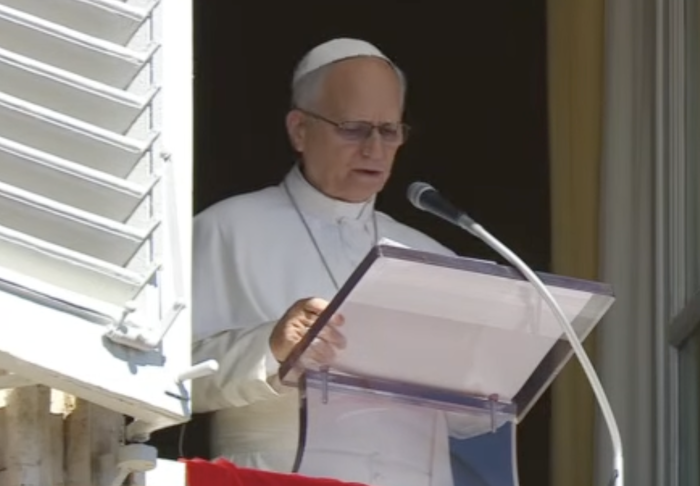
This past Sunday, on Oct. 11, 2026, Robert Prevost (stage name: ‘Pope Leo XIV’) gave his customary brief reflection on the Gospel text of the day during his Angelus address.
This time, the scriptural pericope was Matthew 22:1-14, the parable of the marriage feast (not to be confused with a similar but different parable, that of the great supper, which is found in Luke 14:16-24).
For the sake of clarity, here is the entire passage, taken from the traditional Catholic Douay-Rheims translation:
And Jesus answering, spoke again in parables to them, saying: The kingdom of heaven is likened to a king, who made a marriage for his son. And he sent his servants, to call them that were invited to the marriage; and they would not come. Again he sent other servants, saying: Tell them that were invited, Behold, I have prepared my dinner; my beeves and fatlings are killed, and all things are ready: come ye to the marriage. But they neglected, and went their ways, one to his farm, and another to his merchandise. And the rest laid hands on his servants, and having treated them contumeliously, put them to death. But when the king had heard of it, he was angry: and sending his armies, he destroyed those murderers, and burnt their city. Then he saith to his servants: The marriage indeed is ready; but they that were invited were not worthy. Go ye therefore into the highways; and as many as you shall find, call to the marriage. And his servants going forth into the ways, gathered together all that they found, both bad and good: and the marriage was filled with guests. And the king went in to see the guests: and he saw there a man who had not on a wedding garment. And he saith to him: Friend, how camest thou in hither not having on a wedding garment? But he was silent. Then the king said to the waiters: Bind his hands and feet, and cast him into the exterior darkness: there shall be weeping and gnashing of teeth. For many are called, but few are chosen.
(Matthew 22:1-14)
This beautiful parable no doubt contains a great many spiritual lessons.
The points most noticeable from even just a simple reading of the sacred text would seem to be that (1) those first invited to the marriage were not interested, some even hostile; therefore (2) others were called to the feast in their place; and (3) those that were ultimately present at the wedding were expected to be wearing a certain garment, such that (4) those who weren’t wearing the required garment were expelled and punished in the exterior darkness.
Clearly, then, we ought not to turn down the divine invitation. Furthermore, we must ensure we are properly clothed for the occasion, lest we be destroyed or cast out to a place of torment. Merely heeding the call is not enough; we must also prove ourselves worthy of the invitation.
Yet, what does ‘His Holiness’ Leo XIV do with this teaching of Our Lord?
The fact that the parable is first and foremost a divine warning to mankind does not seem to occur to this ‘Pope’. Instead of making clear that all of us are the ones to whom the invitation is directed, Prevost at first suggests we are like the king or his messengers. After all, like them, we too may experience rejection:
Unfortunately, this can happen to us, too, for the good we offer to do is not always understood, recognized or appreciated. Indeed, at times, it is willfully misinterpreted and rejected. Yet this must not discourage us. When faced with rejection, the king does not call off the wedding or cancel the celebrations. On the contrary, he extends his invitation to an even greater number of people, sending his servants out into the streets to call them so that the bride and groom’s joy may be a gift for all.
(Antipope Leo XIV, Angelus Address, Vatican.va, Oct. 11, 2026)
Next, Leo explicitly raises the question of “whom the main characters in this story represent”, and this is where it gets interesting. He says: “Saint Jerome identifies the king as the Heavenly Father, the bridegroom as Jesus, and the bride as the Church (cf. Commentary on Matthew, Book III, ch. 22).”
Indeed, this much is true. It turns out that St. Jerome has more to say, however. Here is the passage to which ‘Pope’ Leo refers:
This king who made the marriage for his son is the omnipotent God. Now he makes a marriage for our Lord Jesus Christ and the Church, which has been gathered from Jews as well as from Gentiles. He sends his servant to call those who are invited to the marriage. It is scarcely to be doubted that this refers to Moses, through whom he gave the Law to those who were invited. But if we read “servants” as the majority of copies have, it is to be referred to the prophets, because those who were invited by them to come despised the invitation.
(St. Jerome, Commentary on Matthew; in Thomas P. Halton, ed., The Fathers of the Church: A New Translation, vol. 117, trans. by Thomas P. Scheck [Washington, D.C.: The Catholic University of America Press, 2008], p. 248)
Unlike Leo XIV, the illustrious Church Father does not shy away from speaking about the Jews, both the good — those who converted and are therefore part of the Church, the bride in the parable — and the bad — those who, despite repeated efforts, rejected the invitation, some of them even mistreating and killing the messengers.
Curiously, Prevost is interested only in identifying the king, the groom, and the bride in the parable, and not the king’s servants, the people who refuse the invitation, nor those who end up at the marriage feast without a wedding garment. Yet, it would seem that their identity is just as important if we want to make sure we do not misunderstand what Christ wishes to teach us (cf. Lk 8:10; Acts 8:30-32; 2 Pet 3:16).
Regarding those to who reject the king’s invitation, St. Jerome writes:
There is great diversity among those who do not receive the truth of the Gospel. For the ones who are occupied in other matters and do not want to come are guilty of a lesser crime than those who despise the friendliness of the one who invited them and turn humanity into cruelty and who seize the king’s servants, and either treat them shamefully or kill them.
(St. Jerome, Commentary on Matthew; in Halton, The Fathers of the Church, vol. 117, p. 249)
Although there are clearly different degrees of unfaithfulness, the point here is that all those who do not follow the invitation to the marriage banquet are “those who do not receive the truth of the Gospel” after it has been proposed to them.
With regard to those the king destroyed with his armies, burning their cities, St. Jerome comments: “His armies are either his avenging angels … or we may understand the Romans under the leadership of Vespasian and Titus, who killed the people of Judea and set fire to the sinful city” (p. 249).
On all of this, Leo XIV is silent. He does not want to dwell on those who spurn the king, or on their punishment. Instead, he proclaims:
We are among the main characters as well, chosen by the Lord to share our lives with him and to be bearers of life with him. The wedding feast is ours, and the banquet hall is our churches and homes, the places where we live and where the King’s Son, Jesus Christ, continues to declare his love for us and await our “yes.” We encounter him there, and are clothed like a bride in the white garment of Baptism and adorned with the jewels of good works, which draw us closer to God and to one another.
Leo entirely glosses over the conclusion of the parable with its all-important lesson, which is: We are all called by God to the Kingdom of Heaven, and we reject the invitation at our own peril. But even if we heed the call, we must be sure to enter clothed with the garment of charity (sanctifying grace), else we will end in hell, that place of eternal darkness and torment.
Instead of inculcating this important message in his hearers, Prevost draws a conclusion about “joy” that is supposedly “as beautiful as the faces of the people we meet”; and he babbles about “the work, the smiles, the tears, the handshakes, and the acts of kindness that fill our days” — as if the parable of the wedding feast were about any of that!
Clearly, eternal damnation in hell is not something the Vatican II Church likes to speak about, and Leo XIV is no exception. Nevertheless, damnation is a reality, a possibility so real that God Himself came to earth to save us from it: “For God sent not his Son into the world, to judge the world, but that the world may be saved by him” (Jn 3:17). God the Son “emptied himself” (Phil 2:7), took on a human nature, and came to redeem us through His most Holy Passion and Death and to teach us the way of salvation: “He came unto his own, and his own received him not. But as many as received him, he gave them power to be made the sons of God, to them that believe in his name” (Jn 1:11-12).
At the end of his reflection, Prevost does manage to mention “the salvation of the world”, but only in the context of the “joy we proclaim” being “a gift of God” for it.
Yes, if one tries really hard, one can spin these obscure words into something approaching an encouragement to evangelize so that souls will be saved, but one doesn’t have to. One of the things that has characterized the ‘New Theology’ of Vatican II from the beginning is precisely this deliberate and needless obfuscation of things that were clear and comprehensible before.
Leo ends his reflection with this exhortation: “Even when it is not understood, let us proclaim this joy always and everywhere, with generosity, courage and faith.” He could have led by example and expounded this parable of the marriage feast correctly; but then the bound hands and feet, the exterior darkness, and the weeping and gnashing of teeth would have probably rained on his ‘joy’ parade.
In his Angelus address, Prevost says nothing about how the parable ends. He also entirely omits any mention of the famous saying, “many are called, but few are chosen”, with which Our Lord concludes the lesson.
None of this is terribly surprising, however. The reality of eternal punishment simply does not jibe well with the counterfeit church’s false gospel of perpetual joy, infinite dignity, and universal inclusion. Consequently, Leo XIV, like his predecessor ‘Pope’ Francis, simply ignores or reinterprets those Bible passages that don’t fit the desired narrative.
A good case in point is Francis’ Gospel reflection of June 25, 2023:
Leo XIV may not be an exact clone of Francis, but he certainly is yet another adherent and promoter of the Vatican II religion, and so it would be absurd to expect Catholicism from him.
This whole episode demonstrates how the problem with the Vatican II religion does not only lie in what it actually puts forward but also in what it habitually does not say, what it leaves out — for the truth can be distorted not just by what is said but also by how it is said and by what is not said. The same goes for actions: Truth can be denied by what is done, how it is done, or what is not done.
Hence Pope St. Pius X said that Modernists can be identified by “their tenets, their manner of speech, and their action” (Encyclical Pascendi Dominici Gregis, n. 3).
Image source: YouTube (screenshot)
License: fair use

 ;
No Comments
Be the first to start a conversation