
Theology has consequences…
Bad Theology, Invalid Episcopacy: Fr. Anthony Ward Consecrated by Novus Ordo Bishop, Dismisses Vatican Excommunication

Fr. Anthony Ward (b. 1948) was ordained a priest for the Society of St. Pius X (FSSPX) by Archbishop Marcel Lefebvre on Apr. 14, 1973. Four years later, he left the Society and established the Servants of the Holy Family (Servi Sanctae Familiae) in Colorado Springs, Colorado.
On Nov. 16, 2025, Fr. Ward announced that he had secretly been consecrated a bishop in the traditional Roman rite by ‘Archbishop’ Telesphore George Mpundu (b. 1947), retired ordinary of Lusaka, Zambia. The ceremony took place on Mar. 19, 2024, and of course the required ‘papal’ mandate was missing.
Since the consecration took place without the required mandate from Leo XIV, for which Novus Ordo canon law legislates an automatic excommunication latae sententiae (Canon 1387), the Vatican issued a notification that the excommunication had been incurred. The cleric who notified Mpundu and Ward of the censure was none other than the mystical porn author and kissing expert ‘Cardinal’ Victor Manuel Fernandez.
Here are some links pertaining to the recent developments, from various sources:
- Excommunication for traditionalist clergyman “ordained bishop” in the US without the Pope’s authorization (Zenit)
- Servants of the Holy Family founder breaks silence on excommunication after covert consecration (Catholic Herald)
- Audio: Announcement from Bp. Anthony Ward (Nov. 16, 2025)
- PDF: Monograph in Defense of Our Catholic Faith and on the Consecration of the Most Reverend Anthony D. Ward (Nov. 18, 2025)
Ward’s consecration is problematic both in terms of its validity and also in terms of its theological justification, as we will see shortly; but first things first.
A Legacy of Lefebvrism
Fr. Ward has been a long-time adherent of recognize-and-resist traditionalism, which means he accepts ‘Pope’ Leo XIV and his Novus Ordo predecessors as true Popes while refusing submission to them as he deems warranted based on traditional (i.e., pre-Vatican II) Catholic teaching and practice. (Interestingly enough, the traditional Catholic teaching on the Papacy is somehow always left aside, but more on that later.)
Although Ward left the SSPX early on, this was not for doctrinal reasons. In a 14-page defense of their position and Fr. Ward’s consecration, the Servants of the Holy Family relate some history:
Although Archbishop Marcel Lefebvre’s doctrine was thoroughly Catholic, many of his policies were disastrous in the practical order; and because of his acceptance and ordination of unworthy candidates (who were Americanist, heretical or immoral in their behavior), and after numerous attempts of expressing his concerns and his desire to resign, the then-Father Ward felt forced to leave the Society of St. Pius X.
(“Monograph in Defense of Our Catholic Faith and on the Consecration of the Most Reverend Anthony D. Ward”, Servants of the Holy Family, Nov. 18, 2025, p. 3)
Ward’s recent ‘episcopal consecration’ appears to represent the high point of his resistance to recognized Church authority to date.
The Servants of the Holy Family have never been recognized by the local Novus Ordo authorities or the Vatican, although they did maintain contacts with Rome in the hopes of attaining ‘full communion’ status at some point. Eventually, however, they gave up. According to their own testimony, it took them 36 years to figure out they’re dealing with enemies of the Faith:
From 1977 to 2013, Bishop Ward had numerous meetings and correspondence with the Bishops of the Diocese of Colorado Springs and the Archdiocese of Denver, the former Apostolic Delegates and Papal Nuncios of Rome to the United States in Washington, DC, Bishops of the Dioceses of Gallup, New Mexico; Anápolis, Brazil; Comayagua, Honduras. He also met in person with or communicated with the former heads of the Ecclesia Dei commission, Augustin Cardinal Mayer and Darío Cardinal Castrillón Hoyos. These countless communications were for the purpose of receiving official status as a recognized com- munity in the Catholic Church. After thirty-six years of following the standard procedure of a community seeking approval from the local bishop, the priests of Servants of the Holy Family realized that they were not dealing with honorable bishops and priests, but rather men who were thoroughly infested with the heresy of Modernism, concerned with suppressing the Traditional Latin Mass, changing true Catholic Doctrine and persecuting faithful Catholics.
(“Monograph in Defense of Our Catholic Faith”, p. 3)
The Servants’ desire to adhere loyally to the true Catholic Faith (as it was known before the Second Vatican Council) is laudable. However, it is precisely that Faith which also demands loyal adherence to the Catholic hierarchy. This is a conundrum recognize-and-resist traditionalism cannot solve.
For a Roman Catholic, submitting loyally to the Holy See never presents a threat to his Faith, since it is papal doctrine that adherence to the hierarchy is the surest way to stay orthodox:
Indeed one simple way to keep men professing Catholic truth is to maintain their communion with and obedience to the Roman Pontiff. For it is impossible for a man ever to reject any portion of the Catholic faith without abandoning the authority of the Roman Church. In this authority, the unalterable teaching office of this faith lives on. It was set up by the divine Redeemer and, consequently, the tradition from the Apostles has always been preserved. So it has been a common characteristic both of the ancient heretics and of the more recent Protestants — whose disunity in all their other tenets is so great — to attack the authority of the Apostolic See. But never at any time were they able by any artifice or exertion to make this See tolerate even a single one of their errors.
(Pope Pius IX, Encyclical Nostis et Nobiscum, nn. 16-17)
Although any (and almost every) diocese in the world could conceivably fall from the true Faith, abandon communion with the Apostolic See, and become apostate, there is one diocese which is guaranteed by God Himself never to fall, and that is the see of Rome, the Holy See: “…no particular part of the Church is indefectibly Apostolic, save the see of Peter, which is universally known by way of eminence as the Apostolic See”, notes Fr. E. Sylvester Berry (The Church of Christ: An Apologetic and Dogmatic Treatise [St. Louis, MO: B. Herder Book Co., 1927], p. 141; italics removed).
What renders the Servants’ (and the Lefebvrists’) position absurd is their insistence that the anti-Catholic Modernists occupying the Catholic structures today constitute the true and lawful Roman Catholic hierarchy. It is impossible that this be so, for in the true Roman Catholic religion, submission to the Pope and one’s own local bishop in communion with the Holy See is what guarantees adherence to the true Catholic Faith, as we just saw.
Judging Their Own Case
It won’t come as much of a surprise that Fr. Ward does not believe his excommunication is valid. In fact, he is happy to simply ignore the censure and hold it as being of no effect, continuing his ministry regardless of the penalties the (supposedly) lawful authorities have confirmed he has incurred.
In the monograph defending Fr. Ward’s episcopal consecration, the Servants of the Holy Family declare in no uncertain terms what they think of the (supposedly lawful) Vatican II hierarchy’s penalties against them:
First of all, we state in the strongest and most unequivocal terms, that these processes, decisions and documents are absolutely null and void. They are to be and will be ignored and condemned by Bishop Ward and by all the undersigned Priests of Servants of the Holy Family. Every true, sincere and faithful Catholic in the world will do the same.
No authority, regardless of its rank or privilege, can rightly issue punishments to an individual who is innocent of the accusations unjustly leveled against him. Their attempted decrees are unjust, unlawful and invalid. Any excommunication regarding Bishop Ward, whether in the past or present, is phony and without any real effect. The statements of these malicious clergy are contemptible and without any force of law. They come from men without honor who should have the greatest shame.
(“Monograph in Defense of Our Catholic Faith”, p. 2)
Unfortunately for the Servants, the attitude they are displaying here is very much contrary to the very traditional Catholic principles they say they wish to uphold.
It may be supposed that only few people in Church history who were punished with excommunication considered their sentence to be valid or just, so the fact that the Servants are refusing to accept it means nothing — it was to be expected.
Now, it is true that an excommunication can be pronounced unjustly, in which case it is indeed null and void in reality, despite external appearances. However, the Church being a visible society of laws and right order, it obviously cannot be up to the accused to be both judge and jury of his own case, even to the point of pronouncing on the validity of his own sentence. Were it so, the Church could never really punish anyone, since just about everyone would say that in his particular case, the punishment is not just because he acted out of genuine necessity or had some other serious justification for transgressing the law of the Church. (Certainly George Tyrrell [1861-1909], excommunicated under Pope St. Pius X for Modernism, didn’t think his sentence was just, and so he ignored it and continued to disseminate his heretical ideas and even publicly critiqued the encyclical Pascendi.)
How, then, do we reconcile the nullity of an unjust excommunication with the obligation to submit to the Church’s judgment? We do so by keeping in mind that the Church’s judgment concerns the external forum, the realm of law, which is dependent on what is externally manifest or provable. If indeed the excommunication should be unjust and therefore invalid, this will be so not before the Church but before God, in what’s called the internal forum, the forum of conscience: “for man seeth those things that appear, but the Lord beholdeth the heart” (1 Kgs [Sam] 16:7). Until the Church rescinds or annuls the excommunication, there will be a disparity between what is truly the case and what is recognized as factual by the Church.
Relying on Divine Providence and God’s guidance of His Church, we may rest assured that such disparities between the law and actual fact will be rare; but they certainly can and no doubt do exist, as, for example, when a priest has maliciously rendered a sacrament invalid by secretly withholding his intention — something that will never be known to anyone unless and until he discloses it.
Pope St. Pius X himself, when he published his scathing denunciation of the Modernists in 1907, reminded the world’s bishops that his judgment pertained to the external forum only. He was not pretending or presuming to judge their souls:
Although they express their astonishment that We should number them amongst the enemies of the Church, no one will be reasonably surprised that We should do so, if, leaving out of account the internal disposition of the soul, of which God alone is the Judge, he considers their tenets, their manner of speech, and their action.
(Pope Pius X, Encyclical Pascendi Dominici Gregis, n. 3; underlining added.)
Note well: Although God alone judges “the internal disposition of the soul”, we can and must nonetheless denounce the Modernists as “enemies of the Church” on account of what is externally manifest: “their tenets, their manner of speech, and their action”!
What all this means is that even if an excommunication should have been declared unjustly and therefore be void, it must still be considered as valid and binding in the external forum.
Even Unjust Excommunications are Binding
That an unjust (and therefore invalid) excommunication must nevertheless be treated in the external forum as if it were valid and binding is not merely an opinion of canonists but the magisterial teaching of the Roman Pontiffs.
While this may seem odd at first sight, upon second thought it is only reasonable because otherwise no one would ever have to consider himself bound by ecclesiastical punishment, and the Church would then be unable really to discipline wayward members.
On Sep. 8, 1713, Pope Clement XI issued the Apostolic Constitution Unigenitus, in which he condemned the Jansenist errors of Pasquier Quesnel (1634-1719), among which are the following:
CONDEMNED: The fear of an unjust excommunication should never hinder us from fulfilling our duty; never are we separated from the Church, even when by the wickedness of men we seem to be expelled from it, as long as we are attached to God, to Jesus Christ, and to the Church herself by charity.
CONDEMNED: To suffer in peace an excommunication and an unjust anathema rather than betray truth, is to imitate St. Paul; far be it from rebelling against authority or of destroying unity.
(Pope Clement XI, Apostolic Constitution Unigenitus, nn. 91-92; Denz. 1441-1442)
It would seem, then, that the Servants of the Holy Family are justifying their position by relying on some condemned errors of Jansenism.
Furthermore, rebellion against the lawful authority — which, we must never forget, the Servants believe the Modernist hierarchy to be — under the veneer of being the ‘real’ Catholics, has been tried before in Church history. Pope Pius IX, for example, had no sympathy for it, and he even renewed the condemnation of Quesnel’s errors:
The chief deceit used to conceal the new schism is the name of “Catholic.” The originators and adherents of the schism presumptuously lay claim to this name despite their condemnation by Our authority and judgment. It has always been the custom of heretics and schismatics to call themselves Catholics and to proclaim their many excellences in order to lead peoples and princes into error….
But to prove that they are Catholics, the neo-schismatics appeal to what they call a declaration of faith, published by them on February 6, 1870, which they insist disagrees in no regard with the Catholic faith. However it has never been possible to prove oneself a Catholic by affirming those statements of the faith which one accepts and keeping silence on those doctrines which one decides not to profess. But without exception, all doctrines which the Church proposes must be accepted, as the history of the Church at all times bears witness.
That the statement of faith which they published was deceitful and sophistical is proved also by the fact that they rejected the declaration or profession of faith which was proposed to them on Our authority in accordance with custom. … For any man to be able to prove his Catholic faith and affirm that he is truly a Catholic, he must be able to convince the Apostolic See of this. For this See is predominant and with it the faithful of the whole Church should agree. And the man who abandons the See of Peter can only be falsely confident that he is in the Church. As a result, that man is already a schismatic and a sinner who establishes a see in opposition to the unique See of the blessed Peter from which the rights of sacred communion derive for all men.
This fact was well known to the illustrious bishops of the Eastern Churches. Hence at the Council of Constantinople held in the year 536, Mennas the bishop of that city affirmed openly with the approval of the fathers, “We follow and obey the Apostolic See, as Your Charity realizes and we consider those in communion with it to be in communion with us, and we too condemn the men condemned by it.” Even more clearly and emphatically St. Maximus, abbot of Chrysopolis, and a confessor of the faith, in referring to Pyrrhus the Monothelite, declared: “If he wants neither to be nor to be called a heretic, he does not need to satisfy random individuals of his orthodoxy, for this is excessive and unreasonable. But just as all men have been scandalized at him since the chief man was scandalized, so also when that one has been satisfied, all men will doubtless be satisfied. He should hasten to satisfy the Roman See before all others. For when this See has been satisfied, all men everywhere will join in declaring him pious and orthodox. For that man wastes his words who thinks that men like me must be persuaded and beguiled when he has not yet satisfied and beseeched the blessed Pope of the holy Roman Church. From the incarnate word of God Himself as well as from the conclusions and sacred canons of all holy councils, the Apostolic See has been granted the command, authority and power of binding and loosing for all God’s holy churches in the entire world.” For this reason John, Bishop of Constantinople, solemnly declared — and the entire Eighth Ecumenical Council did so later — “that the names of those who were separated from communion with the Catholic Church, that is of those who did not agree in all matters with the Apostolic See, are not to be read out during the sacred mysteries.” This plainly meant that they did not recognize those men as true Catholics. All these traditions dictate that whoever the Roman Pontiff judges to be a schismatic for not expressly admitting and reverencing his power must stop calling himself Catholic.
Since this does not please the neo-schismatics, they follow the example of heretics of more recent times. They argue that the sentence of schism and excommunication pronounced against them by the Archbishop of Tyana, the Apostolic Delegate in Constantinople, was unjust, and consequently void of strength and influence. They have claimed also that they are unable to accept the sentence because the faithful might desert to the heretics if deprived of their ministration. These novel arguments were wholly unknown and unheard of by the ancient Fathers of the Church. For “the whole Church throughout the world knows that the See of the blessed Apostle Peter has the right of loosing again what any pontiffs have bound, since this See possesses the right of judging the whole Church, and no one may judge its judgment.” The Jansenist heretics dared to teach such doctrines as that an excommunication pronounced by a lawful prelate could be ignored on a pretext of injustice. Each person should perform, as they said, his own particular duty despite an excommunication. Our predecessor of happy memory Clement XI in his constitution Unigenitus against the errors of Quesnell forbade and condemned statements of this kind. These statements were scarcely in any way different from some of John Wyclif’s which had previously been condemned by the Council of Constance and [Pope] Martin V. Through human weakness a person could be unjustly punished with censure by his prelate. But it is still necessary, as Our predecessor St. Gregory the Great warned, “for a bishop’s subordinates to fear even an unjust condemnation and not to blame the judgment of the bishop rashly in case the fault which did not exist, since the condemnation was unjust, develops out of the pride of heated reproof.” But if one should be afraid even of an unjust condemnation by one’s bishop, what must be said of those men who have been condemned for rebelling against their bishop and this Apostolic See and tearing to pieces as they are now doing by a new schism the seamless garment of Christ, which is the Church?
…
But the neo-schismatics say that it was not a case of doctrine but of discipline, so the name and prerogatives of Catholics cannot be denied to those who object. Our Constitution Reversurus, published on July 12, 1867, answers this objection. We do not doubt that you know well how vain and worthless this evasion is. For the Catholic Church has always regarded as schismatic those who obstinately oppose the lawful prelates of the Church and in particular, the chief shepherd of all. Schismatics avoid carrying out their orders and even deny their very rank. Since the faction from Armenia is like this, they are schismatics even if they had not yet been condemned as such by Apostolic authority. For the Church consists of the people in union with the priest, and the flock following its shepherd. Consequently the bishop is in the Church and the Church in the bishop, and whoever is not with the bishop is not in the Church. Furthermore, as Our predecessor Pius VI warned in his Apostolic letter condemning the civil constitution of the clergy in France, discipline is often closely related to doctrine and has a great influence in preserving its purity. In fact, in many instances, the holy Councils have unhesitatingly cut off from the Church by their anathema those who have infringed its discipline.
But the neo-schismatics have gone further, since “every schism fabricates a heresy for itself to justify its withdrawal from the Church.” Indeed they have even accused this Apostolic See as well, as if We had exceeded the limits of Our power in commanding that certain points of discipline were to be observed in the Patriarchate of Armenia. Nor can the Eastern Churches preserve communion and unity of faith with Us without being subject to the Apostolic power in matters of discipline. Teaching of this kind is heretical, and not just since the definition of the power and nature of the papal primacy was determined by the ecumenical [First] Vatican Council: the Catholic Church has always considered it such and abhorred it. Thus the bishops at the ecumenical Council of Chalcedon clearly declared the supreme authority of the Apostolic See in their proceedings; then they humbly requested from Our predecessor St. Leo confirmation and support for their decrees, even those which concerned discipline.
(Pope Pius IX, Encyclical Quartus Supra, nn. 6-10, 12-13; underlining added.)
The foregoing demonstrates the absurdity of the recognize-and-resist position, which does not shy away even from declaring an excommunication to be of no effect, thereby contradicting the judgment of (what is claimed to be) the Holy See and in fact presuming to pass judgment on its judgment, which is anathema. It is putting one’s own private judgment over the official judgment of the Apostolic See! What presumption! What folly!
‘But Saint Athanasius!’
At this point in the discussion, some readers may object that St. Athanasius was once excommunicated by Pope Liberius, and yet we know that this censure was unjust and did not deter the saint. The problem with this argument is quite simply that it is not true. As Pope Pius IX remarked, “…previously the Arians falsely accused Liberius, also Our predecessor, to the Emperor Constantine, because Liberius refused to condemn St. Athanasius, Bishop of Alexandria, and refused to support their heresy” (Encyclical Quartus Supra, n. 16; underlining added).
Furthermore, the Church historian Bp. Karl Joseph Hefele wrote:
[The historian] Sozomen says that lies were circulated at the expense of Pope Liberius, namely, that he gave his sanction to the Anomoean doctrine. Neither can it be denied that spurious letters were ascribed to him as well as to S. Athanasius: to this class belongs, first of all, the correspondence between Liberius and Athanasius, unconditionally acknowledged to be spurious, and, what is of still more importance to us, a letter from Liberius to the Oriental bishops, contained in the same fragment of Hilary, and beginning with the words studens paci. That this must of necessity be spurious, we have already said, and it was so recognised by Baronius; the Benedictine editors of S. Hilary and the Bollandist, P. Stilting, have also proved it in detail.
(Right Rev. Charles Joseph Hefele, A History of the Councils of the Church, Vol. II [Edinburgh: T. & T. Clark, 1876], p. 239; underlining added.)
For further, detailed investigation into the Liberius-Athanasius controversy, please see the following two links:
- The Alleged Fall of Pope Liberius, His Alleged Excommunication of St. Athanasius, and other Anti-Papal Libels
- A Response to ‘Bishop’ Athanasius Schneider’s Claims against Pope Liberius
What do we want, then? Do we want the Servants of the Holy Family to submit to the Modernist authorities?
Of course not. Rather, we want them to operate their ministry on sound Catholic principles and not on the basis of Lefebvrist drive-by theology. That begins with recognizing that heresies and other pernicious doctrinal errors, as well as evil laws, fraudulent saints, and unholy liturgical rites cannot proceed from the Catholic Church’s highest authority. The only possible conclusion, therefore, is that the ‘Popes’ since Vatican II have been fake popes, charlatans, usurpers, false prophets, wolves in shepherd’s clothing with no authority from Christ whatsoever. Any other conclusion turns Catholicism upside down, doing untold damage to the Faith and to souls, wittingly or not.
Once more let us take to heart the words of Pope Pius IX, who underscored that it is not enough to recognize the Pope if one does not also submit to him:
What good is it to proclaim aloud the dogma of the supremacy of St. Peter and his successors? What good is it to repeat over and over declarations of faith in the Catholic Church and of obedience to the Apostolic See when actions give the lie to these fine words? Moreover, is not rebellion rendered all the more inexcusable by the fact that obedience is recognized as a duty? Again, does not the authority of the Holy See extend, as a sanction, to the measures which We have been obliged to take, or is it enough to be in communion of faith with this See without adding the submission of obedience, — a thing which cannot be maintained without damaging the Catholic Faith?
…In fact, Venerable Brothers and beloved Sons, it is a question of recognizing the power (of this See), even over your churches, not merely in what pertains to faith, but also in what concerns discipline. He who would deny this is a heretic; he who recognizes this and obstinately refuses to obey is worthy of anathema.
(Pope Pius IX, Encyclical Quae in Patriarchatu [Sept. 1, 1876], nn. 23-24; in Acta Sanctae Sedis X [1877], pp. 3-37; English taken from Papal Teachings: The Church, nn. 433-434.)
And no, an appeal to ‘Eternal Rome’ will not help either.
The Question of Validity
Aside from these legal and doctrinal issues, however, there is another problem with Ward’s ordination as a bishop: that of sacramental validity. Ward’s episcopal consecration was administered by a Novus Ordo bishop; it is therefore only as valid or invalid as the consecrator himself. (Please note that this assessment is not meant as an attack on the character of Fr. Ward or the Rev. Mpundu, it is simply meant to accurately present the situation at hand, without fear or favor.)
Let’s review the facts.
Telesphore Mpundu was ordained bishop on June 21, 1987, according to the Novus Ordo rite of ‘Pope’ Paul VI. His priestly ordination had occurred on Dec. 17, 1972, likewise in the Novus Ordo rite. While it is possible that Mpundu is a validly ordained priest — the change in the rite renders the sacrament doubtful but not clearly invalid — he is definitely not a valid bishop, for the new ordination rite manifestly does not fulfill even the minimum requirements for a valid episcopal consecration.
What this means is that Fr. Ward is not a bishop. He does not possess the fullness of holy orders and therefore does not have the power to ordain, consecrate holy oils, or administer confirmation. Ward took great care to ensure his consecration ceremony would take place in the traditional rite, but his ordaining bishop’s didn’t. No doubt Fr. Ward personally considers the new ordination rites to be valid, but that does not make them so.
What, then, is the problem with the new rite of the ordination of bishops? In a nutshell, it is this: While the essential ordination prayer in the new rite of episcopal consecration may be referring to the Holy Ghost when it speaks of the Spiritus Principalis (“Governing Spirit”) — although even that is questionable — it nevertheless fails to express what the Holy Ghost is supposed to accomplish in the ordinand.
Now, it is Catholic teaching that, to be valid, the essential form of a sacrament must signify the grace it confers: “…the Sacraments of the New Law, as sensible signs which produce invisible grace, must both signify the grace which they produce and produce the grace which they signify” (Pope Pius XII, Apostolic Constitution Sacramentum Ordinis, n. 2). An ordination prayer that does not of itself express that the ordinand receive the power of the episcopacy, cannot confer this power. Even if the surrounding words and actions of the rite express the episcopacy, the Catholic teaching is that the essential form itself must express this, not the words outside of this form.
All of this is fleshed out in detail in the following resources:
- Unholy Orders: 50 Years of Invalid Ordinations in the Novus Ordo Church
- They Are Really Not Bishops: Response to Fr. Hunwicke’s Challenge
Of course the certainty to be acquired here is only as strong as the evidence presented, but even those who are not convinced of the invalidity of the new rite of ordination would have to concede that the evidence is strong enough to render the sacrament doubtful. But doubtful sacraments must be treated as invalid in practice, since there is a real possibility of invalidity. Ergo, Fr. Ward cannot be considered a valid bishop.
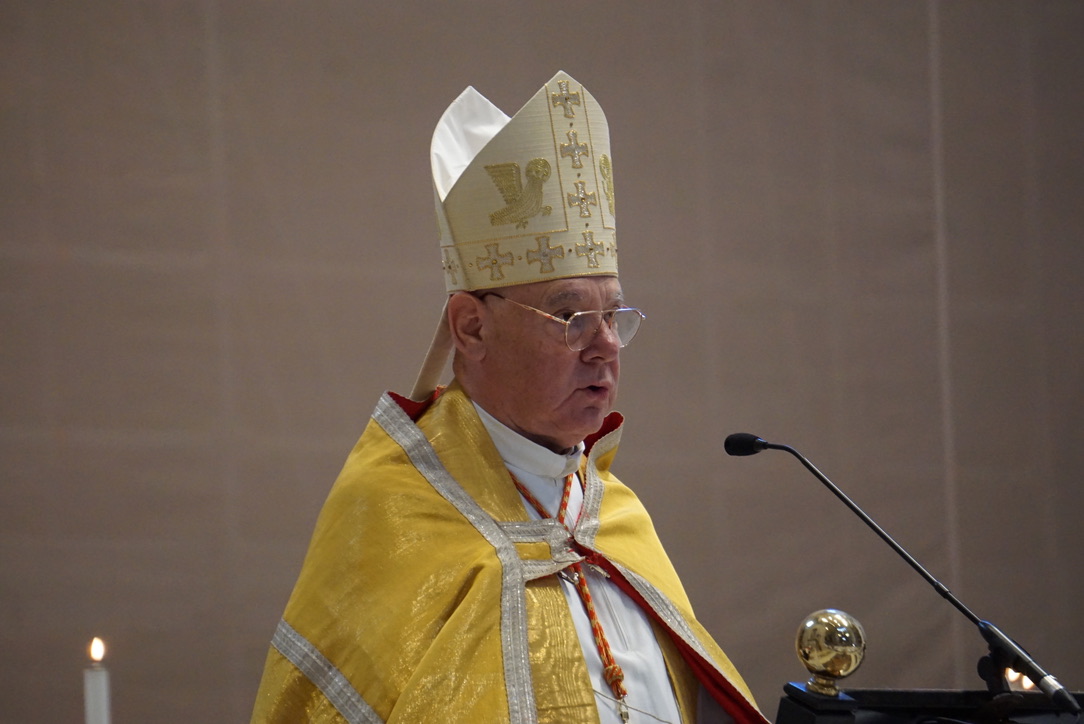
 ‘Abp.’ Mpundu and ‘Bp.’ Ward (image: Servants of the Holy Family Facebook page)
Inevitably, some people will claim that we’re saying Ward’s episcopal consecration was invalid only because he is not a sedevacantist, but that is not so. There have been many episcopal consecrations in the past by non-sedevacantist traditionalists, and we always consider them valid unless there is evidence to the contrary.
Thus, for example, we do not dispute the consecrations of Bp. Jean-Michel Faure, Bp. Tomas de Aquino, or Bp. Gerardo Zendejas, all conferred by the late Bp. Richard Williamson. Nor do we dispute the validity of the consecration of the Modernist Bp. Fernando Arêas Rifan (because one of his co-consecrators, Licínio Rangel, was a valid bishop) or the hippie Modernist Bp. Thomas Gumbleton (because he was consecrated on May 1, 1968, just weeks before ‘Pope’ Paul VI introduced the Novus Ordo rite). We go by Catholic principle here, not by emotion, passion, or theological tit-for-tat.
The invalidity of ‘Bishop’ Ward is tragic, because in the end, nobody ‘wins’ when invalid sacraments are administered to souls in good faith who are only trying to be true Catholics.
This entire episode underscores once more, however, just how true the saying is that theology has consequences.
Image source: Facebook
License: fair use

 ;
;
No Comments
Be the first to start a conversation